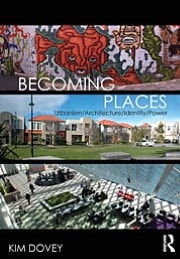
Becoming Places: Urbanism/Architecture/Identity/Power
0
0
As an Amazon Associate and affiliate partner, Menrva Books earns from qualifying purchases. Learn more
Author Description
About the practices and politics of place and identity formation – the slippery ways in which who we are becomes wrapped up with where we are – this book exposes the relations of place to power. It links everyday aspects of place experience to the social theories of Deleuze and Bourdieu in a very readable manner. This is a book that takes the social critique of built form another step through detailed fieldwork and analysis in particular case studies.Through a broad range of case studies from nationalist monuments and new urbanist suburbs to urban laneways and avant garde interiors, questions are explored such as: What is neighborhood character? How do squatter settlements work and does it matter what they look like? Can architecture liberate? How do monuments and public spaces shape or stabilize national identity?
Menrva's Summary
THE THESIS
This book investigates the complex, often invisible mechanisms through which physical environments and built forms construct human identity and reinforce structures of power. Author Kim Dovey, an expert in architecture and urban design, synthesizes social theory with empirical observation to argue that place-making is a political act. By applying the concepts of Deleuze and Bourdieu to the built environment, the text provides a framework for understanding how spatial configurations influence social behavior and national consciousness.
THE SCOPE MAP
What You Will Find
- Analysis of the relationship between urban design and the formation of social identity.
- Application of social theories from Deleuze and Bourdieu to architectural practice.
- Detailed case studies ranging from nationalist monuments to informal squatter settlements.
- Examination of how public spaces and urban laneways function as sites of power and resistance.
THE AUTHORITY PERSPECTIVE
Experts recognize this work as a significant contribution to the intersection of urban studies and critical social theory. Readers frequently note that the text successfully bridges the gap between abstract philosophical concepts and practical, real-world architectural analysis.
Page Count:
201
Publication Date:
2010-01-01
Publisher:
Routledge
ISBN-10:
0203875001
ISBN-13:
9780203875001
Architecture
Sociology
Social Theory
Urbanism
Architecture and society
urban planning
Community Tags
Similar Books