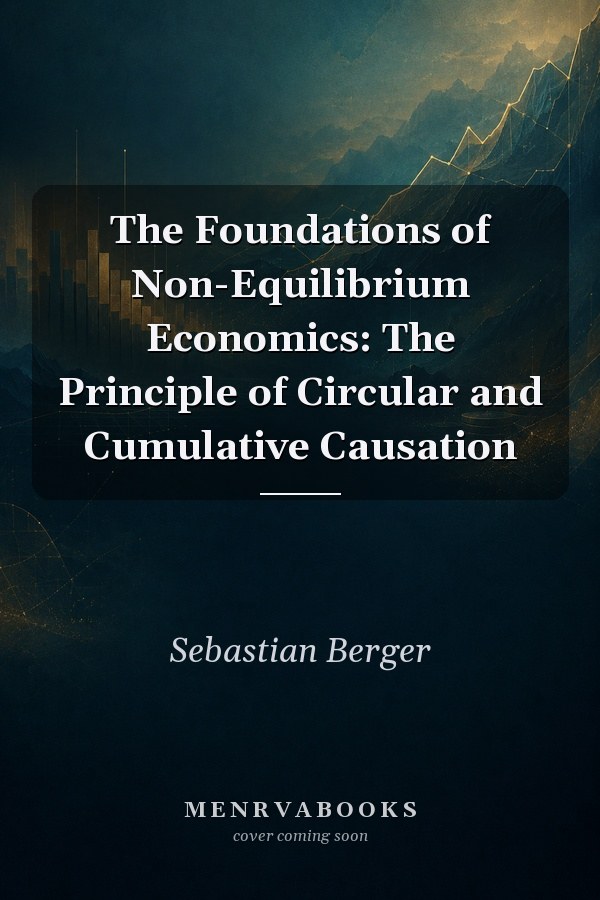
The Foundations of Non-Equilibrium Economics: The Principle of Circular and Cumulative Causation
0
0
As an Amazon Associate and affiliate partner, Menrva Books earns from qualifying purchases. Learn more
Author Description
This Thought-provoking Volume Presents Essays On The Foundations Of Non-equilibrium Economics, I.e. The Principle Of Circular Cumulative Causation (ccc). This Work Presents Empirical Research On How The Interplay Of Technology's Increasing Returns To Scale, Institutions, Resources, And Economic Policy Leads To Virtuous Circles Of Economic Growth And Development, But Also To Vicious Circles Of Social And Ecological Degradation. In Particular, Evidence Is Provided For The Important Role Of The Development State And Strategic Trade Policy, Economies Of Large-scale Production In Manufacturing, The Regional Level Of Development And Community-based Resource Management Regimes. While Demonstrating Ccc's Strength In Generating Empirical Research, The Book Also Provides Insights Into Its Philosophical Foundations And Intellectual History. Several Essays Trace The Roots Of This Full-fledged Theoretical Framework Back To Adam Smith, Classical Political Economy, Thorstein Veblen, Gunnar Myrdal, K. William Kapp And Nicholas Kaldor. As The Most Comprehensive Collection Of The Growing Body Of Ccc Research To Date, This Book Also Reflects The Emergence Of An Economic Paradigm For Understanding Economic Dynamics And For Crafting Viable Development Strategies For The 21st Century. The Volume Will Be Of Great Interest To Scholars Of Growth And Development Economics, Institutional And Evolutionary Economics, Political Economy, And Post Keynesian Economics From Undergraduate To Postgraduate Research Levels.
Menrva's Summary
THE THESIS
This volume investigates the theoretical and empirical validity of the principle of Circular and Cumulative Causation (CCC) as a framework for understanding non-equilibrium economic dynamics. Sebastian Berger, alongside various contributors, synthesizes historical intellectual foundations with modern empirical research to argue that economic growth is driven by the interplay of technology, institutions, and policy. The text posits that these interactions create self-reinforcing cycles that can lead to either development or degradation, challenging traditional equilibrium-based economic models.
THE SCOPE MAP
What You Will Find
- Historical analysis of economic thought from Adam Smith to Gunnar Myrdal and Nicholas Kaldor.
- Empirical research on the role of the developmental state and strategic trade policy.
- Examination of increasing returns to scale in manufacturing and regional development patterns.
- Case studies on community-based resource management and the socio-ecological impacts of economic cycles.
THE AUTHORITY PERSPECTIVE
Experts identify this collection as a comprehensive resource for scholars interested in institutional and post-Keynesian economic paradigms. Readers frequently note the academic density of the prose, which is tailored for students and researchers engaged in advanced economic theory.
Page Count:
0
Publication Date:
2009-01-01
Publisher:
Routledge
ISBN-10:
0203873734
ISBN-13:
9780203873731
Economics
Causation
Evolutionary Economics
Community Tags
Similar Books