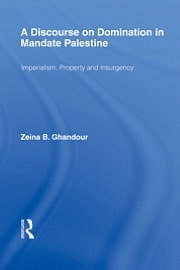
A Discourse On Domination In Mandate Palestine: Imperialism, Property And Insurgency
0
0
As an Amazon Associate and affiliate partner, Menrva Books earns from qualifying purchases. Learn more
Author Description
British discourse during the Mandate, with its unremitting convergence on the problematic 'native question', and which rested on racial and cultural theories and presumptions, as well as on certain givens drawn from the British class system, has been taken for granted by historians. The validity of cultural representations as pronounced within official correspondence and colonial laws and regulations, as well as within the private papers of colonial officials, survives more or less intact. There are features of colonialism additional to economic and political power, which are glaring yet have escaped examination, which carried cultural weight and had cultural implications and which negatively transformed native society. This was inevitable. But what is less inevitable is the subsequent collusion of historians in this, a (neo-) colonial dynamic. The continued collusion of modern historians with racial and cultural notions concerning the rationale of European rule in Palestine has postcolonial implications. It drags these old notions into the present where their iniquitous barbarity continues to manifest. This study identifies the symbolism of British officials' discourse and intertwines it with the symbolism and imagery of the natives' own discourse (from oral interviews and private family papers). At all times, it remains allied to those writers, philosophers and chroniclers whose central preoccupation is to agitate and challenge authority. This, then, is a return to the old school, a revisiting of the optimistic, vibrant rhetoric of those radicals who continue to inspire post and anti-colonial thinking. In order to dismantle, and to undo and unwrite, A Discourse on Domination in Mandate Palestine holds a mirror up to the language of the Mandatory by counteracting it with its own integrally oppositional discourse and a provocative rhetoric.
Menrva's Summary
THE THESIS
This work investigates how British colonial discourse in Mandate Palestine utilized racial and cultural theories to justify imperial rule and how modern historiography has inadvertently perpetuated these colonial frameworks. Zeina B. Ghandour, a legal scholar and writer, examines the intersection of colonial administration, property law, and native resistance. By analyzing official correspondence, colonial regulations, and private papers, the author argues that the language of the Mandate was not merely administrative but a tool of cultural transformation that continues to influence contemporary political perceptions.
THE SCOPE MAP
What You Will Find
- Analysis of British colonial administrative records and legal regulations in Mandate Palestine.
- Comparative study of official imperial rhetoric versus native oral histories and family archives.
- Examination of the role of property and class systems in reinforcing colonial hierarchies.
- Theoretical framework for deconstructing and challenging neo-colonial historical narratives.
THE AUTHORITY PERSPECTIVE
Scholars in postcolonial studies and Middle Eastern history recognize this text as a critical intervention in the historiography of the British Mandate. Readers frequently note the provocative, polemical nature of the prose, which intentionally aligns with radical anti-colonial traditions to challenge established academic norms.
Page Count:
216
Publication Date:
2010-01-01
Publisher:
Routledge
ISBN-10:
0203880846
ISBN-13:
9780203880845
History
Middle East
Imperialism
Public opinion
Mandates
British
School Administrators
Colonialism
Community Tags
Similar Books