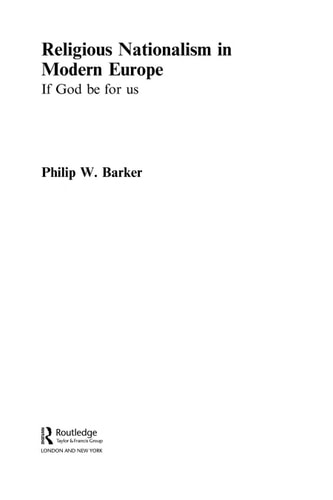
Religious Nationalism in Modern Europe: If God Be for Us
0
0
As an Amazon Associate and affiliate partner, Menrva Books earns from qualifying purchases. Learn more
Author Description
This volume examines the enduring nature of religious nationalism in modern Europe. Through a series of in-depth case studies covering Ireland, England, Poland, and Greece; the author argues that religious frontiers, or geographic lines of division between different and unique religions, are central to the formation of religiously-based national identities.Typically, as states develop economically and politically, religion plays a lesser role in both individual lives and national identity. However, at religious frontiers, religion becomes useful for differentiating and mobilizing groups of people. This is particularly true when the religious frontier also represents a threat or conflict. Although religion may not be the root of conflict in these instances, the conflict takes on religious tones because of its ability to unite an otherwise diverse population. Religion takes precedence over language, culture, or other national building-blocks because the other can best be distinguished in religious terms. The in-depth case studies allow for a deep historical understanding of the processes which converge to create a modern religious nation.Greatly expanding our current understanding of the conditions in which religious nationalism develops, this important book has implications for our understanding of religion and politics, secularization, European politics and foreign policy.
Menrva's Summary
THE THESIS
This book investigates the persistence of religious nationalism in modern Europe by questioning why religion remains a potent force for identity and mobilization in specific geographic contexts. Philip W. Barker, a scholar of political science, utilizes a comparative framework to analyze how religious frontiers function as catalysts for national identity formation. He argues that in areas where religious lines of division exist, religion serves as a primary tool for group differentiation and political mobilization, often superseding secular markers like language or culture.
THE SCOPE MAP
What You Will Find
- Comparative case studies of Ireland, England, Poland, and Greece.
- An analysis of the 'religious frontier' concept as a driver for national identity.
- Historical and political examination of how religion is utilized during periods of conflict or perceived threat.
- Theoretical implications for the study of secularization, foreign policy, and state development.
THE AUTHORITY PERSPECTIVE
Experts recognize this work as a significant contribution to the study of religion and politics, particularly for its focus on the geographic conditions that sustain religious nationalism. Scholars frequently highlight the clarity of the case studies as a useful resource for understanding the intersection of historical identity and modern statecraft.
Page Count:
210
Publication Date:
2008-01-01
Publisher:
Routledge
ISBN-10:
0203892844
ISBN-13:
9780203892848
Religion
Nationalism
Sociology
European History