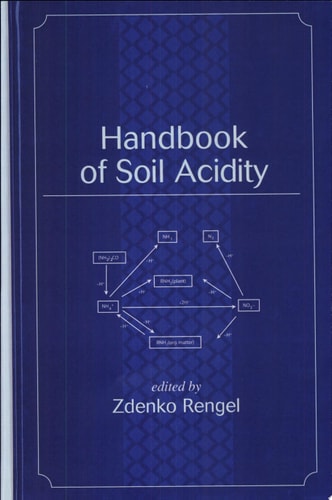
Handbook of Soil Acidity
0
0
As an Amazon Associate and affiliate partner, Menrva Books earns from qualifying purchases. Learn more
Author Description
This handbook offers effective strategies to modify and adjust crop production processes to decrease the toxicity of soil contaminants, balance soil pH, improve root growth and nutrient uptake, and increase agricultural yield. The Handbook of Soil Acidity provides methods to, measure soil acidity, determine the major causes of soil acidification, calculate acidification rates for specific crop sequences, identify high-risk areas for soil acidification, and model acidification phenomena. This is an essential resource for plant, crop, soil, and environmental scientists, plant and crop physiologists, botanists, agronomists, agriculturists, and upper-level undergraduate, graduate, and continuing-education students in these disciplines.
Menrva's Summary
THE THESIS
This handbook investigates the chemical and biological mechanisms of soil acidification to provide actionable strategies for optimizing crop production and soil health. Author Zdenko Rengel compiles extensive research on the factors contributing to soil pH imbalance, offering a comprehensive framework for scientists and agronomists to assess, model, and mitigate acidity-related toxicity in agricultural environments. The text integrates physiological data with practical management techniques to improve nutrient uptake and root development across diverse crop sequences.
THE SCOPE MAP
What You Will Find
- Quantitative methods for measuring soil acidity and calculating acidification rates.
- Analytical models for predicting acidification phenomena in various soil types.
- Strategies for balancing soil pH to enhance agricultural yield and root growth.
- Identification protocols for high-risk areas prone to soil acidification.
THE AUTHORITY PERSPECTIVE
Experts recognize this volume as a technical reference for professionals and advanced students in plant and soil sciences. Readers frequently note the academic density of the prose, which serves as a foundational resource for those engaged in environmental management and agricultural research.
Page Count:
512
Publication Date:
2003-01-01
Publisher:
Taylor & Francis Group
ISBN-10:
0203912314
ISBN-13:
9780203912317
Science
Soil Science
Agriculture
Botany
Agronomy
Soil acidity
Community Tags
Other Editions(3)
Similar Books














