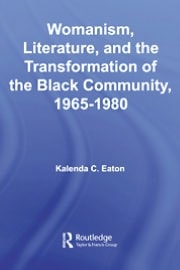
Womanism, Literature, and the Transformation of the Black Community, 1965-1980
0
0
As an Amazon Associate and affiliate partner, Menrva Books earns from qualifying purchases. Learn more
Author Description
This book examines how cultural and ideological reactions to activism in the post-Civil Rights Black community were depicted in fiction written by Black women writers, 1965–1980. By recognizing and often challenging prevailing cultural paradigms within the post-Civil Rights era, writers such as Toni Morrison, Alice Walker, Toni Cade Bambara, and Paule Marshall fictionalized the black community in critical ways that called for further examination of progressive activism after the much publicized 'end' of the Civil Rights Movement. Through their writings, the authors’ confronted marked shifts within African American literature, politics and culture that proved detrimental to the collective 'wellness' of the community at large.
Menrva's Summary
THE THESIS
This book investigates how Black women writers between 1965 and 1980 utilized fiction to critique and reshape ideological responses to activism within the post-Civil Rights Black community. Kalenda Eaton, a scholar of African American literature, analyzes the intersection of political shifts and creative expression during this transformative period. By examining the works of prominent authors, the text argues that these writers identified and challenged cultural paradigms that threatened the collective well-being of their communities following the formal conclusion of the Civil Rights Movement.
THE SCOPE MAP
What You Will Find
- Analysis of literary works by Toni Morrison, Alice Walker, Toni Cade Bambara, and Paule Marshall.
- Examination of the socio-political climate in the United States from 1965 to 1980.
- Investigation into the concept of womanism as a framework for community activism.
- Evaluation of how fiction serves as a primary source for understanding cultural shifts in African American history.
THE AUTHORITY PERSPECTIVE
Scholars and students of African American literature frequently cite this work for its precise focus on the intersection of gender, politics, and narrative form. Experts highlight the text as a valuable resource for understanding the evolution of Black feminist thought and its manifestation in mid-twentieth-century fiction.
Page Count:
107
Publication Date:
2007-01-01
Publisher:
New York ; Routledge, 2008.
ISBN-10:
020393590X
ISBN-13:
9780203935903
History
Literary Criticism
Women authors
African American
Sociology
African Americans
Community Tags
Similar Books