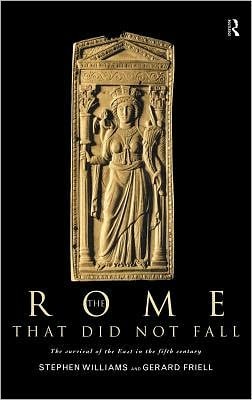
The Rome That Did Not Fall
0
0
As an Amazon Associate and affiliate partner, Menrva Books earns from qualifying purchases. Learn more
Author Description
The Rome that Did Not Fall provides a well-illustrated, comprehensive narrative and analysis of the Roman empire in the east, charting its remarkable growth and development which resulted in the distinct and enduring civilization of Byzantium. It considers: * the fourth century background * the invasions of Attila * the resources of the east * the struggle for stability * the achievements of Anastasius.
Menrva's Summary
THE THESIS
This work investigates the historical mechanisms and geopolitical factors that allowed the Eastern Roman Empire to survive and evolve into the enduring civilization of Byzantium while the West collapsed. The authors, Gerard Friell and Stephen J. Williams, utilize a combination of primary source analysis and historical narrative to examine the transition from late antiquity to the Byzantine era. They argue that the strategic management of resources, military adaptation, and administrative reforms were critical to the survival of the East during a period of widespread instability. By focusing on the fourth and fifth centuries, the text provides a framework for understanding how the Eastern Roman state maintained its structural integrity against external and internal pressures.
THE SCOPE MAP
What You Will Find
- Analysis of the fourth-century political and social background of the Roman Empire.
- Detailed examination of the military threats posed by the invasions of Attila the Hun.
- Assessment of the economic and human resources available to the Eastern provinces.
- Evaluation of the administrative and fiscal achievements under the reign of Emperor Anastasius.
- Discussion of the struggle for internal stability and the consolidation of imperial power.
THE AUTHORITY PERSPECTIVE
Experts and historians frequently cite this work as a clear and accessible introduction to the survival of the Eastern Roman Empire. Readers often note the balance between narrative history and analytical depth, making it a useful resource for students and those interested in the transition to the Byzantine period.
Page Count:
304
Publication Date:
1998-01-01
Publisher:
Routledge
ISBN-10:
0203982312
ISBN-13:
9780203982310
History
Byzantine History
Roman Empire
Ancient History
Community Tags
Similar Books