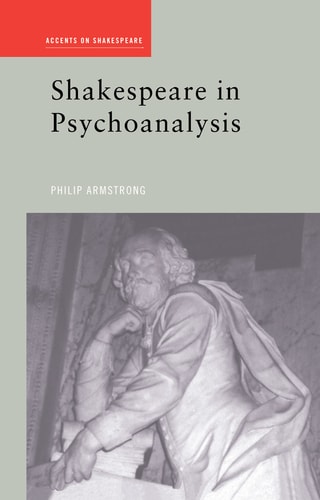
Shakespeare in Psychoanalysis
0
0
As an Amazon Associate and affiliate partner, Menrva Books earns from qualifying purchases. Learn more
Author Description
The Link Between Psychoanalysis As A Mode Of Interpretation And Shakespeare's Works Is Well Known. But Rather Than Merely Putting Shakespeare On The Couch, Philip Armstrong Focuses On The Complex And Fascinatingly Fruitful Mutual Relationship Between Shakespeare's Texts And Psychoanalytic Theory. He Shows How The Theories Of Freud, Rank, Jones, Lacan, Erikson, And Others Are Themselves In A Large Part The Product Of Reading Shakespeare. Armstrong Provides An Introductory Cultural History Of The Relationship Between Psychoanalytic Concepts And Shakespearean Texts. This Is Played Out In A Variety Of Expected And Unexpected Contexts, Including: *the Early Modern Stage *hamlet And The Tempest *freud's Analytic Session *the Parisian Intellectual Scene *hollywood *the Virtual Space Of The Pc.
Menrva's Summary
THE THESIS
This book investigates the reciprocal relationship between Shakespearean drama and the development of psychoanalytic theory. Philip Armstrong, a scholar of early modern literature, argues that psychoanalysis is not merely a tool for interpreting Shakespeare, but that the foundational texts of psychoanalysis were themselves shaped by the reading of Shakespearean plays. By examining the history of this intellectual exchange, Armstrong demonstrates how the two fields have co-evolved to define modern understandings of the human subject.
THE SCOPE MAP
What You Will Find
- A cultural history of the intersection between psychoanalytic concepts and Shakespearean texts.
- Analysis of key figures including Freud, Rank, Jones, Lacan, and Erikson.
- Case studies ranging from the early modern stage and specific plays like Hamlet and The Tempest to modern contexts like Hollywood and digital media.
- An examination of the analytic session as a site of literary performance.
THE AUTHORITY PERSPECTIVE
Experts recognize this work as a significant contribution to the history of literary theory and the reception of Shakespeare. Readers frequently note the academic density of the prose, which provides a rigorous framework for understanding how psychoanalysis and literature inform one another.
Page Count:
288
Publication Date:
2005-01-01
Publisher:
Taylor & Francis Group
ISBN-10:
020399602X
ISBN-13:
9780203996027
Psychology
Cultural History
Psychoanalysis
Literary Criticism
Shakespeare
In literature
Community Tags
Other Editions(3)

Similar Books