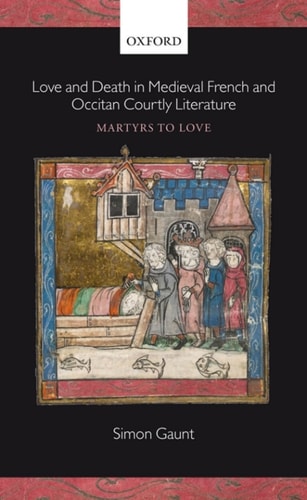
Love and Death in Medieval French and Occitan Courtly Literature: Martyrs to Love
0
0
As an Amazon Associate and affiliate partner, Menrva Books earns from qualifying purchases. Learn more
Author Description
Some of medieval culture's most arresting images and stories inextricably associate love and death. Thus the troubadour Jaufre Rudel dies in the arms of the countess of Tripoli, having loved her from afar without ever having seen her. Or in Marie de France's Chevrefoil, Tristan and Iseult's fatal love is hauntingly symbolized by the fatally entwined honeysuckle and hazel. And who could forget the ethereal spectacle of the Damoisele of Escalot's body carried to Camelot on a supernatural funerary boat with a letter on her breast explaining how her unrequited love for Lancelot killed her? Medieval literature is fascinated with the idea that love may be a fatal affliction. Indeed, it is frequently suggested that true love requires sacrifice, that you must be ready to die for, from, and in love. Love, in other words, is represented, sometimes explicitly, as a form of martyrdom, a notion that is repeatedly reinforced by courtly literature's borrowing of religious vocabulary and imagery. The paradigm of the martyr to love has of course remained compelling in the early modern and modern period. This book seeks to explore what is at stake in medieval literature's preoccupation with love's martyrdom. Informed by modern theoretical approaches, particularly Lacanian psychoanalysis and Jacques Derrida's work on ethics, it offers new readings of a wide range of French and Occitan courtly texts from the twelfth and thirteenth centuries, and argues that a new secular ethics of desire emerges from courtly literature because of its fascination with death. This book also examines the interplay between lyric and romance in courtly literary culture and shows how courtly literature's predilection for sacrificial desire imposes a repressive sex-gender system that may then be subverted by fictional women and queers who either fail to die on cue, or who die in troublesome and disruptive ways.
Menrva's Summary
THE THESIS
This book investigates the cultural and ethical implications of the recurring association between love and death in medieval French and Occitan courtly literature. Simon Gaunt, a scholar of medieval literature, utilizes a framework grounded in Lacanian psychoanalysis and the ethical theories of Jacques Derrida to analyze how courtly texts employ religious imagery to frame romantic desire as a form of martyrdom. By examining the intersection of lyric and romance, the author argues that this preoccupation with sacrificial desire establishes a distinct secular ethics while simultaneously reinforcing and challenging gender and sexual norms of the twelfth and thirteenth centuries.
THE SCOPE MAP
What You Will Find
- Analysis of twelfth and thirteenth-century French and Occitan courtly texts.
- Application of Lacanian psychoanalytic theory to medieval literary tropes.
- Examination of the interplay between religious vocabulary and secular romantic narratives.
- Discussion of gender and queer subversion within the context of sacrificial death.
Scope Limits
- The analysis is restricted to the specific cultural context of medieval French and Occitan courtly literature.
- The text does not provide a comprehensive history of the martyr trope outside of the medieval and early modern literary tradition.
THE AUTHORITY PERSPECTIVE
Scholars in the field of medieval studies recognize this work as a sophisticated application of modern critical theory to canonical courtly texts. Readers frequently note the academic density of the prose and the rigor with which Gaunt navigates the complex relationship between ethics, desire, and gender performance.
Page Count:
256
Publication Date:
2006-01-01
Publisher:
OUP Oxford
ISBN-10:
0191534021
ISBN-13:
9780191534027
French literature
Gender Studies
English & College Success
Cultural History
English
Literary Criticism
In literature
Community Tags
Other Editions(2)

Similar Books











Reader Comments
Share Your Thoughts
No comments yet. Be the first to share your thoughts!