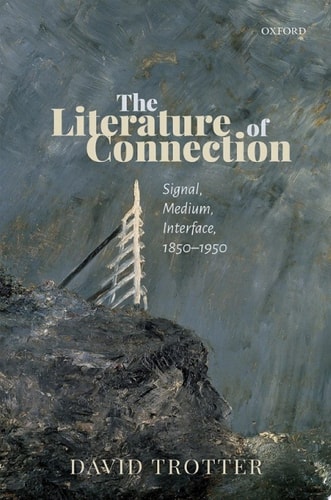
The Literature of Connection: Signal, Medium, Interface, 1850-1950
0
0
As an Amazon Associate and affiliate partner, Menrva Books earns from qualifying purchases. Learn more
Author Description
This book is about some of the ways in which the world got ready to be connected, long before the advent of the technologies and the concentrations of capital necessary to implement a global 'network society'. It investigates the prehistory not of the communications 'revolution' brought about by advances in electronic digital computing from 1950 onwards, but of the principle of connectivity which was to provide that revolution with its justification and rallying-cry. Connectivity's core principle is that what matters most in any act of telecommunication, and sometimes all that matters, is the fact of its having happened. During the nineteenth century, the principle gained steadily increasing traction by means not only of formal systems such as the telegraph, but of an array of improvised methods and signalling devices. These methods and devices fulfilled not just an ever more urgent need, but a fundamental recurring desire, for near-instantaneous real-time communication at a distance. Connectivity became an end in itself: a complex, vivid, unpredictable romance woven through the enduring human desire and need for remote intimacy. Its magical enhancements are the stuff of tragedy, comedy, satire, elegy, lyric, melodrama, and plain description; of literature, in short. The book develops the concepts of signal, medium, and interface to offer, in its first part, an alternative view of writing in Britain from George Eliot and Thomas Hardy to D.H. Lawrence, Hope Mirrlees, and Katherine Mansfield; and, in its second, case-studies of European and African-American fiction, and of interwar British cinema, designed to open the topic up for further enquiry.
Menrva's Summary
THE THESIS
This book investigates the historical emergence of the principle of connectivity as a cultural and social imperative, tracing its development from 1850 to 1950. David Trotter, a scholar of modernism and media history, examines how the desire for near-instantaneous communication preceded the digital age. He argues that the act of connection itself became a primary focus of human interaction, influencing both the technological systems of the era and the literary forms that sought to represent them.
THE SCOPE MAP
What You Will Find
- Analysis of communication technologies including the telegraph and various signaling devices.
- A conceptual framework utilizing the terms signal, medium, and interface.
- Literary case studies ranging from George Eliot and Thomas Hardy to D.H. Lawrence and Katherine Mansfield.
- Examinations of interwar British cinema and African-American fiction.
Scope Limits
- The text does not cover the post-1950 era of electronic digital computing or the modern network society.
- It does not provide a comprehensive history of telecommunications infrastructure, focusing instead on the cultural and literary implications of connectivity.
THE AUTHORITY PERSPECTIVE
Scholars frequently identify this work as a significant contribution to the intersection of media studies and literary history. Experts note that the prose is academically rigorous and provides a sophisticated framework for understanding how early communication technologies shaped modern narrative forms.
Page Count:
293
Publication Date:
2020-01-01
Publisher:
OUP Oxford
ISBN-10:
0192591045
ISBN-13:
9780192591043
History
In literature
Motion pictures
Technology and Society
Media Studies
Indigenous
Cultural History
Literary Criticism
Communication History
Community Tags
Similar Books