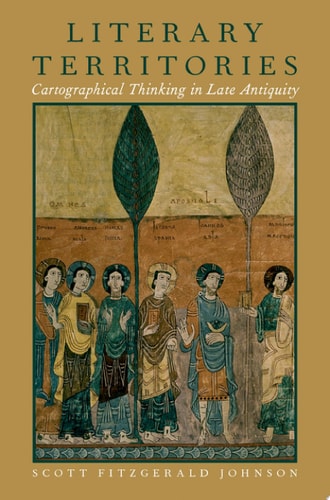
Literary Territories: Cartographical Thinking in Late Antiquity
0
0
As an Amazon Associate and affiliate partner, Menrva Books earns from qualifying purchases. Learn more
Author Description
Literary Territories introduces readers to a wide range of literature from 200-900 CE in which geography is a defining principle of literary art. From accounts of Holy Land pilgrimage, to Roman mapmaking, to the systematization of Ptolemy's scientific works, Literary Territories argues that forms of literature that were conceived and produced in very different environments and for different purposes in Late Antiquity nevertheless shared an aesthetic sensibility which treated the classical "inhabited world," the oikoumene, as a literary metaphor for the collection and organization of knowledge. This type of "cartographical thinking" stresses the world of knowledge that is encapsulated in the literary archive. The archival aesthetic coincided with an explosion of late antique travel and Christian pilgrimage which in itself suggests important unifying themes between visual and textual conceptions of space. Indeed, by the end of Late Antiquity the geographical mode appears in nearly every type of writing in multiple Christian languages (Greek, Latin, Syriac, and others). The diffusion of cartographical thinking throughout the real-world oikoumene, now the Christian Roman Empire, was a fundamental intellectual trajectory of Late Antiquity.
Menrva's Summary
THE THESIS
How did the conceptualization of geography function as a primary organizational framework for literary production between 200 and 900 CE? Scott Fitzgerald Johnson, a scholar of Late Antiquity, examines the intersection of spatial representation and intellectual history. He argues that authors across the Christian Roman Empire utilized the concept of the oikoumene—the inhabited world—as a metaphor for the systematic collection and categorization of knowledge within the literary archive.
THE SCOPE MAP
What You Will Find
- Analysis of diverse texts including pilgrimage accounts, Roman cartography, and scientific treatises.
- Examination of the archival aesthetic in Greek, Latin, and Syriac literature.
- Exploration of the relationship between physical travel and textual representations of space.
Scope Limits
- The study focuses primarily on the period between 200 and 900 CE.
- It does not provide an exhaustive catalog of all geographical texts, but rather focuses on the intellectual trend of cartographical thinking.
THE AUTHORITY PERSPECTIVE
Scholars recognize this work as a significant contribution to the study of late antique intellectual history and the evolution of spatial thought. Readers frequently note the academic density of the prose and the author's success in bridging the gap between visual cartography and textual literary forms.
Page Count:
209
Publication Date:
2016-01-01
Publisher:
Oxford University Press
ISBN-10:
0190493348
ISBN-13:
9780190493349
History
Literary Criticism
Geography
Ancient History
English & College Success
Cultural History
English
Late Antiquity
Community Tags
Similar Books