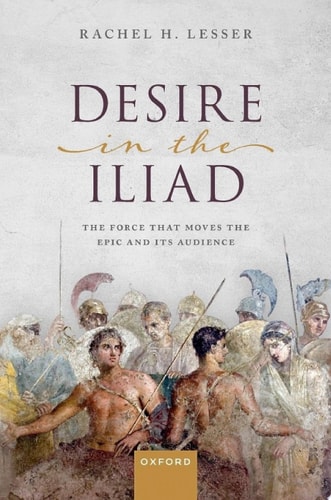
Desire in the Iliad: The Force That Moves the Epic and Its Audience
0
0
As an Amazon Associate and affiliate partner, Menrva Books earns from qualifying purchases. Learn more
Author Description
This is the first study to examine desire in the Iliad in a comprehensive way, and to explain its relationship to the epic's narrative structure and audience reception. Rachel H. Lesser offers a new reading of the poem that shows how the characters' desires, especially those of the mortal hero Achilleus and the divine king Zeus, motivate plot and keep the audience engaged with the epic until and even beyond its end. The author argues that the characters' desires are primarily organized in narrative triangles that feature two parties in conflict over a third. A variety of desires animate these triangles, including sexual passion, longing for a lost loved one, yearning for lamentation, and aggressive desires for vengeance and status, and they are signified with terms such as eros, himeros, pothe, menos, thumos, boule, and eeldor, as well as through the epic's thematic emotions of grief and anger. Desire in the Iliad shows how the mortals' and gods' triangular desires together drive and shape two Iliadic plots, the main plot of Achilleus' withdrawal from the fighting and then return to battle, and the "superplot" of the larger Trojan War story. The author also argues that these plots and their motivating desires arouse the listener's-or reader's-own corresponding desires: narrative desire to know and understand the Iliad's full story, sympathetic desire for characters' welfare, and empathetic passions, longings, and wishes. Our desires invest us in the epic narrative and their resolution brings us satisfaction.
Menrva's Summary
THE THESIS
This study investigates how the concept of desire functions as the primary engine for narrative progression and audience engagement within Homer's Iliad. Rachel H. Lesser, a scholar of classical literature, utilizes a structuralist framework to analyze the motivations of both mortal and divine characters. By examining the interplay between Achilleus and Zeus, the author argues that desire is not merely a character trait but a formal mechanism that organizes the epic's plot into complex triangular relationships.
THE SCOPE MAP
What You Will Find
- A structural analysis of narrative triangles involving conflict over a third party
- A linguistic examination of Greek terms for desire including eros, himeros, pothe, menos, and thumos
- An exploration of the relationship between character motivation and reader response
Scope Limits
- The analysis is restricted to the Iliad and does not extend to the Odyssey or other epic cycles
- The study focuses primarily on structural and psychological motivations rather than historical or archaeological context
THE AUTHORITY PERSPECTIVE
Scholars recognize this work as a significant contribution to Homeric studies for its focus on the mechanics of narrative drive. The text is noted for its academic rigor and its ability to bridge the gap between ancient character psychology and modern reader reception theory.
Page Count:
336
Publication Date:
2022-01-01
Publisher:
OUP Oxford
ISBN-10:
019269166X
ISBN-13:
9780192691668
History
Homer
Ancient History
Epic Poetry
Literary Criticism
Community Tags
Similar Books