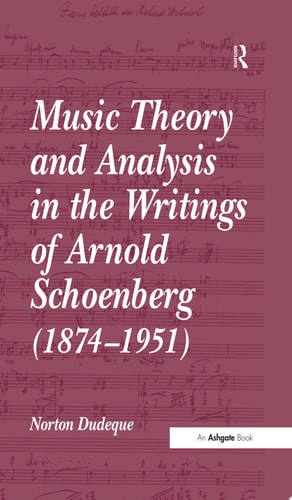
Music Theory and Analysis in the Writings of Arnold Schoenberg (1874-1951)
0
0
As an Amazon Associate and affiliate partner, Menrva Books earns from qualifying purchases. Learn more
Author Description
Arnold Schoenberg's theory of music has been much discussed but his approach to music theory needs a new historical and theoretical assessment in order to provide a clearer understanding of his contributions to music theory and analysis. Norton Dudeque's achievement in this book involves the synthesis of Schoenberg's theoretical ideas from the whole of the composer's working life, including material only published well after his death. The book discusses Schoenberg's rejection of his German music theory heritage and past approaches to music-theory pedagogy, the need for looking at musical structures differently and to avoid aesthetic and stylistic issues. Dudeque provides a unique understanding of the systematization of Schoenberg's tonal-harmonic theory, thematic/motivic-development theory and the links with contemporary and past music theories. The book is complemented by a special section that explores the practical application of the theoretical material already discussed. The focus of this section is on Schoenberg's analytical practice, and the author's response to it. Norton Dudeque therefore provides a comprehensive understanding of Schoenberg's thinking on tonal harmony, motive and form that has hitherto not been attempted.
Menrva's Summary
THE THESIS
This book reassesses Arnold Schoenberg's music theory and analytical practices, offering a comprehensive understanding of his contributions. Norton Dudeque synthesizes Schoenberg's theoretical ideas across his entire career, including posthumously published material, to provide a clearer perspective on his impact. The work examines Schoenberg's departure from German music theory traditions and pedagogical methods, advocating for new ways to approach musical structures independent of aesthetic or stylistic concerns. Dudeque meticulously details the systematization of Schoenberg's tonal-harmonic theory, his thematic/motivic-development theory, and their connections to historical and contemporary music theories.
THE SCOPE MAP
- A synthesis of Arnold Schoenberg's theoretical writings throughout his career.
- An examination of Schoenberg's rejection of his German music theory heritage and pedagogy.
- Analysis of Schoenberg's approach to musical structures, avoiding aesthetic and stylistic biases.
- Detailed exploration of the systematization of Schoenberg's tonal-harmonic theory.
- Discussion of Schoenberg's thematic/motivic-development theory and its links to other theories.
- A dedicated section on the practical application of Schoenberg's theoretical material through his analytical practice.
THE AUTHORITY PERSPECTIVE
The book is regarded as a significant scholarly achievement, providing a much-needed historical and theoretical reassessment of Arnold Schoenberg's music theory. It is praised for its comprehensive synthesis of Schoenberg's ideas, drawing from a wide range of his writings, including previously unpublished materials. The work's detailed exploration of Schoenberg's tonal-harmonic theory, motive development, and analytical practices offers a unique and in-depth understanding that scholars have found invaluable. This meticulous study is considered essential for anyone seeking a deeper comprehension of Schoenberg's intellectual contributions to music theory and analysis.
Page Count:
296
Publication Date:
2017-07-05
Publisher:
Routledge
ISBN-10:
1351557173
ISBN-13:
9781351557177
Music
Non-Fiction
Music theory
Musicology
Music Analysis
Community Tags
Other Editions(4)

Similar Books



Reader Comments
Share Your Thoughts
No comments yet. Be the first to share your thoughts!