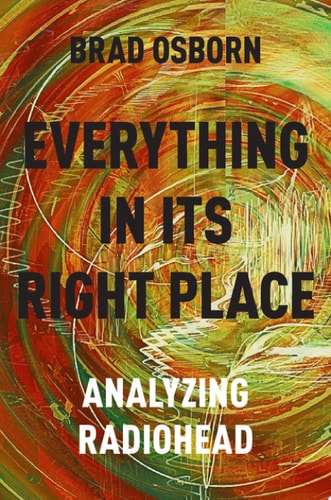
Everything In Its Right Place: Analyzing Radiohead
0
0
As an Amazon Associate and affiliate partner, Menrva Books earns from qualifying purchases. Learn more
Author Description
More Than Any Rock Artist Since The Beatles, Radiohead's Music Inhabits The Sweet Spot Between Two Extremes: On The One Hand, Music That Is Wholly Conventional And Conforms To All Expectations Of Established Rock Styles, And, On The Other Hand, Music So Radically Experimental That It Thwarts Any Learned Notions. While Averting Mainstream Trends But Still Achieving A Significant Level Of Success In Both Us And Uk Charts, Radiohead's Music Includes Many Surprises And Subverted Expectations, Yet Remains Accessible Within A Framework Of Music Traditions. In Everything In Its Right Place: Analyzing Radiohead, Brad Osborn Reveals The Functioning Of This Reconciliation Of Extremes In Various Aspects Of Radiohead's Music, Analyzing The Unexpected Shifts In Song Structure, The Deformation Of Standard 4/4 Backbeats, The Digital Manipulation Of Familiar Rock 'n' Roll Instrumentation, And The Expected Resolutions Of Traditional Cadence Structures. Expanding On Recent Work In Musical Perception, Focusing Particularly On Form, Rhythm And Meter, Timbre, And Harmony, Everything In Its Right Place Treats Radiohead's Recordings As Rich Sonic Ecosystems In Which A Listener Participates In An Individual Search For Meaning, Bringing Along Expectations Learned From Popular Music, Classical Music, Or Even Radiohead's Own Compositional Idiolect. Radiohead's Violations Of These Subjective Expectation-realization Chains Prompt The Listener To Search More Deeply For Meaning Within Corresponding Lyrics, Biographical Details Of The Band, Or Intertextual Relationships With Music, Literature, Or Film. Synthesizing Insights From A Range Of New Methodologies In The Theory Of Pop And Rock, And Specifically Designed For Integration Into Music Theory Courses For Upper Level Undergraduates, Everything In Its Right Place Is Sure To Find Wide Readership Among Scholars And Students, As Well As Avid Listeners Who Seek A Deeper Understanding Of Radiohead's Distinctive Juxtapositional Style.
Menrva's Summary
THE THESIS
How does Radiohead reconcile conventional rock structures with radical experimentalism to create a unique sonic identity? Brad Osborn, a music theorist, utilizes recent developments in musical perception to examine the band's compositional idiolect. By analyzing specific recordings, he argues that Radiohead's subversion of listener expectations forces a deeper engagement with the music's formal, rhythmic, and harmonic components.
THE SCOPE MAP
What You Will Find
- Analysis of song structure, rhythmic deformation, and digital manipulation of instrumentation.
- Application of music theory methodologies to popular music recordings.
- Examination of how listener expectations interact with formal musical elements.
Scope Limits
- The text focuses primarily on musicological analysis rather than a comprehensive biographical history of the band.
- It does not provide a general discography or fan-oriented trivia guide.
THE AUTHORITY PERSPECTIVE
Scholars and music theory students frequently note the academic density of the prose, which is specifically tailored for upper-level undergraduate coursework. Experts highlight this as a rigorous framework for understanding the intersection of popular music traditions and avant-garde compositional techniques.
Page Count:
192
Publication Date:
2016-01-01
Publisher:
Oxford University Press
ISBN-10:
019062924X
ISBN-13:
9780190629243
Analysis
Musicology
Academic
Rock music
Music theory
Community Tags
Other Editions(3)
Similar Books


Reader Comments
Share Your Thoughts
No comments yet. Be the first to share your thoughts!