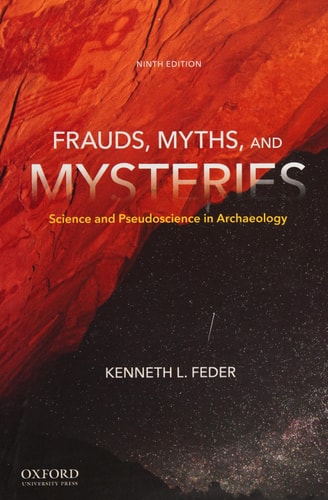
Frauds, Myths, and Mysteries: Science and Pseudoscience in Archaeology
0
0
As an Amazon Associate and affiliate partner, Menrva Books earns from qualifying purchases. Learn more
Author Description
Frauds, myths, and supposed mysteries about humanity's past are moving targets for anyone committed to the scientific investigation of human antiquity. It is important for anyone interested in the human past to know, for example, that there is no evidence for a race of giant human beings in antiquity and no broken shards of laser guns under Egyptian pyramids. Debunking such nonsense is fun and useful in its own way, but more important is the process by which we determine that such claims are bunk.Now published by Oxford University Press, Frauds, Myths, and Mysteries: Science and Pseudoscience in Archaeology, Ninth Edition, uses interesting--and often humorous--archaeological hoaxes, myths, and mysteries to show how we can truly know things about the past through science. It is not just a book about how we know what isn't true about the human past--it's also about how we know what is true.
Menrva's Summary
THE THESIS
How can the scientific method be applied to distinguish legitimate archaeological discovery from fabricated myths and pseudoscientific claims? Kenneth L. Feder, a professor of anthropology, utilizes his extensive academic background to provide a rigorous framework for evaluating historical claims. By contrasting popular misconceptions with empirical evidence, the author demonstrates the necessity of scientific skepticism in understanding human antiquity.
THE SCOPE MAP
What You Will Find
- Analysis of famous archaeological hoaxes and myths
- Methodologies for testing historical claims against physical evidence
- Explanations of how scientific consensus is reached in archaeology
- Case studies involving giants, lost civilizations, and ancient technology
Scope Limits
- Does not provide an exhaustive history of all archaeological discoveries
- Focuses primarily on North American and Western-centric myths rather than global folklore
THE AUTHORITY PERSPECTIVE
Experts frequently cite this text as a foundational resource for undergraduate archaeology courses due to its accessible tone and clear pedagogical structure. Readers often note that the book successfully balances academic rigor with an engaging, critical approach to debunking common misconceptions.
Page Count:
352
Publication Date:
2017-02-01
Publisher:
Oxford University Press
ISBN-10:
0190629657
ISBN-13:
9780190629656
Science
History
Critical thinking
Anthropology
Pseudoscience
Archaeology
Community Tags
Other Editions(3)
Similar Books