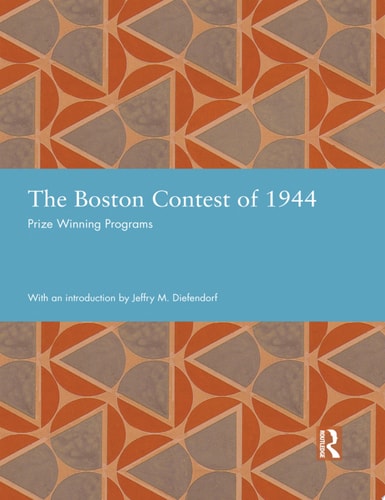
The Boston Contest of 1944: Prize Winning Programs
0
0
As an Amazon Associate and affiliate partner, Menrva Books earns from qualifying purchases. Learn more
Author Description
During World War II, many European government authorities and planners believed that the damage caused by bombing constituted a great opportunity to transform their cities. Even as the fighting continued, a great many plans were drawn up, and this has been the subject of much scholarship. However, what is often overlooked is wartime planning in cities not damaged in the war. United States cities were not bombed, but in Boston, one of its leading cities, the last years of the war brought a major effort to encourage both new plans to modernize the city and also means of implementing those plans. The wartime initiative to transform Boston had several sources. Both the Great Depression and the war had led to major measures by the federal government to try to deal with fiscal challenges and the need for new housing for the many people who relocated during the war because of the creation of new industries to help the war effort. Boston hoped it could benefit from these measures. Moreover, in the late 1930s, Harvard University had become a key residence for figures important in modernist planning, including Joseph Hudnut, Walter Gropius and Martin Wagner. These factors combined in 1944 to inspire what was called The Boston Contest. Its goal was to suggest solutions to many problems found in the metropolitan area. These issues included commercial and industrial developments, housing, transportation, education, recreation, welfare, urban finances, metropolitan government, and citizen participation in solving problems. This book, published in 1945 contains the top 3 prize winning entries and excerpts from 9 of the other nearly 100 entries. It gives a fascinating insight into the developing ideas of urban planning in the United States at a critical juncture.
Menrva's Summary
THE THESIS
The Boston Contest of 1944 sought innovative solutions to modernize a major American city during wartime, despite its lack of direct conflict damage. The book examines the context of urban planning in the United States during World War II, a period when many European cities were being rebuilt after extensive bombing. It highlights how American cities, including Boston, also engaged in significant planning efforts, driven by federal initiatives for housing and fiscal challenges, and influenced by modernist planning thinkers at Harvard University. The contest itself aimed to address a wide array of urban issues, from development and housing to transportation, education, and governance.
THE SCOPE MAP
- Analysis of urban planning initiatives in non-bombed U.S. cities during WWII.
- Exploration of the influence of federal housing and fiscal policies on urban development.
- The role of modernist planning figures from Harvard University in shaping urban ideas.
- Detailed presentation of the top 3 prize-winning entries from The Boston Contest of 1944.
- Excerpts from 9 other entries submitted to the contest, offering a broader view of proposals.
- Discussion of key urban issues addressed: commercial/industrial development, housing, transportation, education, recreation, welfare, finances, metropolitan government, and citizen participation.
- Insight into the evolving ideas of urban planning in the United States at a critical juncture.
THE AUTHORITY PERSPECTIVE
This book offers a unique perspective on urban planning history by focusing on a major American city's proactive modernization efforts during World War II, a topic often overshadowed by post-war European reconstruction. The inclusion of prize-winning plans and excerpts from numerous other entries provides a comprehensive look at the ideas and challenges of the era. The work is valuable for understanding the development of urban planning thought in the United States during a pivotal period. It serves as a historical document detailing the aspirations and strategies for urban transformation.
Page Count:
172
Publication Date:
2015-03-05
Publisher:
Routledge
ISBN-10:
1317506081
ISBN-13:
9781317506089
Non-Fiction
History
Architecture
urban planning
Community Tags
Similar Books