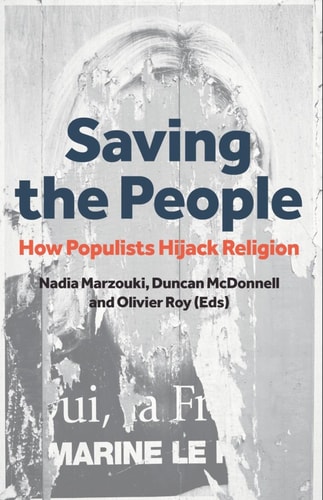
Saving the People: How Populists Hijack Religion
0
0
As an Amazon Associate and affiliate partner, Menrva Books earns from qualifying purchases. Learn more
Author Description
Western democracies are experiencing a new wave of right-wing populism that seeks to mobilize religion for its own ends. With chapters on the United States, Britain, France, Italy, Austria, the Netherlands, Poland and Israel, Saving the People asks how populist movements have used religion for their own ends and how church leaders react to them. The authors contend that religion is more about belonging than belief for populists, with religious identities and traditions being deployed to define who can and cannot be part of 'the people'. This in turn helps many populists to claim that native Christian communities are being threatened by a creeping and highly aggressive process of Islamization, with Muslims becoming a key 'enemy of the people'. While Church elites generally condemn this instrumental use of religions, populists take little heed, presenting themselves as the true saviours of the people. The policy implications of this phenomenon are significant, which makes this book all the more timely and relevant to current debate.
Menrva's Summary
THE THESIS
This book investigates how contemporary right-wing populist movements strategically instrumentalize religious identity to define national belonging and exclude perceived outsiders. The authors, Duncan McDonnell, Nadia Marzouki, and Olivier Roy, utilize a comparative political framework to analyze the intersection of populism and faith across multiple Western democracies. They argue that for these movements, religion functions primarily as a marker of cultural identity rather than a system of belief, serving to mobilize support by framing native populations as victims of external threats.
THE SCOPE MAP
What You Will Find
- Comparative analysis of populist movements in the United States, Britain, France, Italy, Austria, the Netherlands, Poland, and Israel.
- A theoretical framework distinguishing between religion as belief and religion as a tool for social belonging.
- Examination of the rhetorical construction of the 'enemy of the people' through the lens of Islamization narratives.
Scope Limits
- The study does not provide an exhaustive history of all global populist movements.
- The analysis focuses primarily on the interaction between political actors and religious institutions rather than the internal theological developments of the churches themselves.
THE AUTHORITY PERSPECTIVE
Experts recognize this work as a significant contribution to the study of modern political polarization and the secular-religious divide. Readers frequently note the clarity of the comparative approach, which effectively highlights the commonalities in populist strategies across diverse national contexts.
Page Count:
288
Publication Date:
2016-11-01
Publisher:
Oxford University Press
ISBN-10:
0190639016
ISBN-13:
9780190639013
Religion
Populism
Sociology
International relations
Community Tags
Similar Books