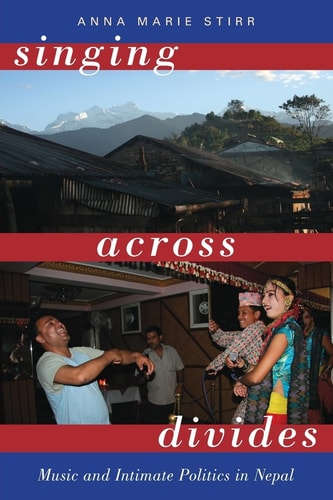
Singing Across Divides: Music and Intimate Politics in Nepal
0
0
As an Amazon Associate and affiliate partner, Menrva Books earns from qualifying purchases. Learn more
Author Description
An ethnographic study of music, performance, migration, and circulation, Singing Across Divides examines how forms of love and intimacy are linked to changing conceptions of political solidarity and forms of belonging, through the lens of Nepali dohori song. The book describes dohori: improvised, dialogic singing, in which a witty repartee of exchanges is based on poetic couplets with a fixed rhyme scheme, often backed by instrumental music and accompanying dance, performed between men and women, with a primary focus on romantic love. The book tells the story of dohori's relationship with changing ideas of Nepal as a nation-state, and how different nationalist concepts of unity have incorporated marginality, in the intersectional arenas of caste, indigeneity, class, gender, and regional identity. Dohori gets at the heart of tensions around ethnic, caste, and gender difference, as it promotes potentially destabilizing musical and poetic interactions, love, sex, and marriage across these social divides.In the aftermath of Nepal's ten-year civil war, changing political realities, increased migration, and circulation of people, media and practices are redefining concepts of appropriate intimate relationships and their associated systems of exchange. Through multi-sited ethnography of performances, media production, circulation, reception, and the daily lives of performers and fans in Nepal and the UK, Singing Across Divides examines how people use dohori to challenge (and uphold) social categories, while also creating affective solidarities.
Menrva's Summary
THE THESIS
This book investigates how the improvised, dialogic musical tradition of Nepali dohori serves as a site for negotiating intimate relationships, social identity, and national belonging in a post-conflict, migratory society. Anna Marie Stirr, an anthropologist and ethnomusicologist, utilizes multi-sited ethnographic research conducted in Nepal and the UK to analyze how performance practices intersect with shifting political realities. By examining the interplay of caste, gender, class, and ethnicity within these musical exchanges, the author argues that dohori functions as a mechanism for both reinforcing and challenging established social hierarchies.
THE SCOPE MAP
What You Will Find
- Analysis of dohori performance structures, including poetic couplets, rhyme schemes, and improvisational techniques.
- Examination of the role of music in the context of Nepal's post-civil war nation-building and increased global migration.
- Ethnographic data gathered from performers, media producers, and fans across diverse geographic locations.
- Discussion of how romantic and intimate interactions in song reflect broader tensions regarding social and ethnic divides.
Scope Limits
- The study focuses primarily on the specific cultural and social context of Nepal and its diaspora, rather than providing a global survey of improvised musical traditions.
- The research does not attempt to provide a comprehensive political history of the Nepali civil war, but rather focuses on the cultural aftermath as expressed through performance.
THE AUTHORITY PERSPECTIVE
Scholars in ethnomusicology and South Asian studies frequently cite this work for its nuanced integration of performance theory with political anthropology. Readers often note the academic density of the prose, which provides a rigorous framework for understanding how intimate cultural practices shape national identity.
Page Count:
312
Publication Date:
2017-10-25
Publisher:
Oxford University Press
ISBN-10:
0190631988
ISBN-13:
9780190631987
Social Life
Music
Humanities
Sociology
Performance Studies
Anthropology
Nepal Studies
Music Asian
Community Tags
Similar Books