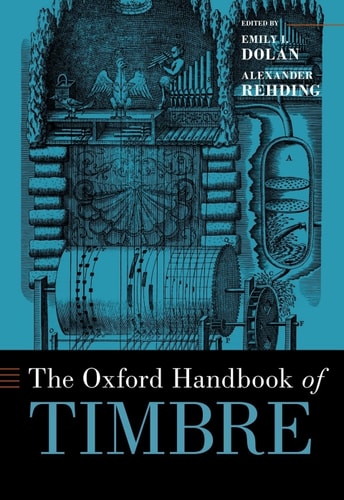
The Oxford Handbook of Timbre
0
0
As an Amazon Associate and affiliate partner, Menrva Books earns from qualifying purchases. Learn more
Author Description
Despite its importance as a central feature of musical sounds, timbre has rarely stood in the limelight. First defined in the eighteenth century, denigrated during the nineteenth, the concept of timbre came into its own during the twentieth century and its fascination with synthesizers and electronic music-or so the story goes. But in fact, timbre cuts across all the boundaries that make up musical thought-combining scientific and artistic approaches to music, material and philosophical aspects, and historical and theoretical perspectives. Timbre challenges us to fundamentally reorganize the way we think about music.The twenty-five essays that make up this collection offer a variety of engagements with music from the perspective of timbre. The boundaries are set as broad as possible: from ancient Homeric sounds to contemporary sound installations, from birdsong to cochlear implants, from Tuvan overtone singing to the tv show The Voice, from violin mutes to Moog synthesizers. What unifies the essays across this vast diversity is the material starting point of the sounding object. This focus on the listening experience is radical departure from the musical work that has traditionally dominated musical discourse since its academic inception in late-nineteenth-century Europe.Timbre remains a slippery concept that has continuously demanded more, be it more precise vocabulary, a more systematic theory, or more rigorous analysis. Rooted in the psychology of listening, timbre consistently resists pinning complete down. This collection of essays provides an invitation for further engagement with the range of fascinating questions that timbre opens up.
Menrva's Summary
THE THESIS
This collection investigates how timbre functions as a central, yet historically overlooked, dimension of musical experience that bridges scientific, artistic, and philosophical domains. Editors Alexander Rehding and Emily I. Dolan compile twenty-five essays that challenge traditional musicological discourse, which has historically prioritized the musical work over the material reality of sound. The contributors argue that by centering the listening experience and the physical sounding object, scholars can reorganize the fundamental framework of musical thought.
THE SCOPE MAP
What You Will Find
- Historical analysis of timbre from the eighteenth century to the present
- Interdisciplinary studies linking acoustics, psychology, and music theory
- Case studies ranging from Homeric soundscapes and bird calls to electronic synthesizers and cochlear implants
Scope Limits
- Does not provide a singular, unified definition of timbre, as the editors acknowledge the concept's inherent resistance to rigid categorization
- Does not focus exclusively on Western classical music traditions
THE AUTHORITY PERSPECTIVE
Experts recognize this volume as a comprehensive survey that successfully elevates timbre to a primary subject of musicological inquiry. Readers frequently note the academic density of the prose, which serves as a foundational resource for researchers and students interested in the intersection of sound studies and music theory.
Page Count:
739
Publication Date:
2021-01-01
Publisher:
Oxford University Press
ISBN-10:
0190637250
ISBN-13:
9780190637255
Sound Studies
Musicology
Music Philosophy
Reference
Earth Sciences
Music theory
Musical Acoustics
Sound
Humanities
Acoustics
Community Tags
Other Editions(2)
Similar Books