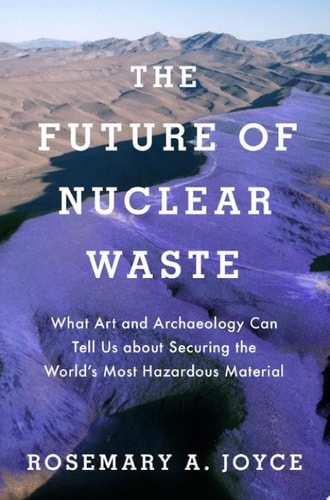
The Future of Nuclear Waste: What Art and Archaeology Can Tell Us about Securing the World's Most Hazardous Material
0
0
As an Amazon Associate and affiliate partner, Menrva Books earns from qualifying purchases. Learn more
Author Description
How can nations ensure that buried nuclear waste goes undisturbed for thousands of years? The United States government tried to solve this problem with the help of experts they identified in communication, materials science, and futurism. From the perspective of a contemporary archaeologist, The Future of Nuclear Waste looks at what these experts suggested, and what the government endorsed: designs for a modern monument, an artificial ruin, a purpose-built archaeological site that would escape future exploration. One design, selected for development, argued that because specific archaeological sites and objects (among them Stonehenge, Serpent Mound, the Rosetta Stone, and rock art) made long ago have endured and are seen as significant today, contemporary engineers could build monuments that would be equally effective in conveying messages that last even longer. An alternative proposal, which government planners set aside, was rooted in the idea that universal archetypes of design arouse similar human emotions in all times and places. Both proposals used common sense, assuming that human reactions and understandings are relatively predictable.Employing an anthropology of common sense, Rosemary Joyce explores why people chosen for their expertise relied on generalizations contradicted by the actual history of preservation and interpretation of archaeological sites and the closest analogues to archetype-based designs, which are the large scale installations produced in the Land Art movement. The book reveals the underlying imagination shared by the experts, government planners, and artists, in which the American West is an empty space available for projects like these. It counters this with the dissenting voices of indigenous scholars and activists who document the presence on these nuclear landscapes of Native American people. The result is an eye-opening and unique demonstration of how a deep understanding of the remote past informs critical debates about the presen
Menrva's Summary
THE THESIS
How can nations effectively communicate the danger of buried nuclear waste to future generations over thousands of years? Rosemary Joyce, an archaeologist, examines the U.S. government's reliance on experts in futurism and materials science to design monuments intended to deter future human interference. She argues that these plans often rely on flawed assumptions about human behavior and universal archetypes, failing to account for the complex history of how archaeological sites are actually preserved and interpreted.
THE SCOPE MAP
What You Will Find
- Analysis of government-commissioned designs for nuclear waste markers, including artificial ruins and monuments.
- Comparative study of historical archaeological sites like Stonehenge and the Rosetta Stone alongside modern Land Art installations.
- Critique of the 'empty space' narrative applied to the American West in nuclear planning.
- Perspectives from indigenous scholars and activists regarding land use and nuclear landscapes.
Scope Limits
- The book does not provide technical engineering specifications for nuclear waste containment vessels.
- It does not offer a definitive policy solution for long-term nuclear waste storage.
THE AUTHORITY PERSPECTIVE
Experts in anthropology and science studies highlight this work as a critical intervention in the intersection of archaeology and contemporary policy. Readers frequently note the accessible yet rigorous prose that challenges the common-sense assumptions of government planners.
Page Count:
298
Publication Date:
2020-01-01
Publisher:
Oxford University Press
ISBN-10:
0190888164
ISBN-13:
9780190888169
History
Non-Fiction
Earth Sciences
Nuclear Energy
Science History
Anthropology
Archaeology
Humanities
Semiotics
Community Tags
Other Editions(2)
Similar Books
Reader Comments
Share Your Thoughts
No comments yet. Be the first to share your thoughts!