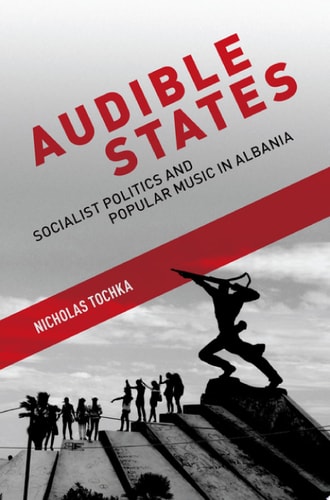
Audible States: Socialist Politics and Popular Music in Albania
0
0
As an Amazon Associate and affiliate partner, Menrva Books earns from qualifying purchases. Learn more
Author Description
During the Cold War, state-sponsored musical performances were central to the diplomatic agendas of the United States and the Soviet Union. But states on the periphery of the conflict also used state-funded performances to articulate their positions in the polarized global network. In Albania in particular, the postwar government invested heavily in public performances at home, effectively creating a new genre of popular music: the wildly popular light music.In Audible States: Socialist Politics and Popular Music in Albania, author Nicholas Tochka traces an aural history of Albania's government through a close examination of the development and reception of light music at Radio-Television Albania's Festival of Song. Drawing on a wide range of archival resources and over forty interviews with composers, lyricists, singers, and bureaucrats, Tochka describes how popular music became integral to governmental projects to improve society--and a major concern for both state-socialist and postsocialist regimes between 1945 and the present. Tochka's narrative begins in the immediate postwar period, arguing that state officials saw light music as a means to cultivate a modern population under socialism. As the Cold War ended, postsocialist officials turned again to light music, now hoping that these musicians could help shape Albania into a capitalist, "European" state. Interweaving archival research with ethnographic interviews, Audible States demonstrates that modern political orders do not simply render social life visible, but also audible.Incorporating insights from ethnomusicology, governmentality studies, and post-socialist studies, Audible States presents an original perspective on music and government that reveals the fluid, pervasive, but ultimately limited nature of state power in the modern world. A remarkably researched and engagingly written study, Audible States is a foundational text in the growing literature on popular music and culture in post-socialist Euro
Menrva's Summary
THE THESIS
How did the Albanian state utilize popular music as a mechanism for governance and social engineering throughout the socialist and post-socialist eras? Nicholas Tochka, an ethnomusicologist, examines the intersection of state power and cultural production by analyzing the development of 'light music' within the context of Radio-Television Albania's Festival of Song. He argues that music served as a primary tool for state officials to cultivate specific national identities, first to foster a socialist citizenry and later to align the nation with European capitalist structures.
THE SCOPE MAP
What You Will Find
- Historical analysis of the Festival of Song from 1945 to the present.
- Theoretical framework integrating governmentality studies with ethnomusicology.
- Primary source data derived from over forty interviews with composers, lyricists, and state bureaucrats.
Scope Limits
- The study focuses primarily on state-sanctioned 'light music' rather than underground or non-state musical movements.
- The analysis is geographically confined to Albania and its specific political transitions.
THE AUTHORITY PERSPECTIVE
Experts recognize this work as a foundational text for understanding the role of culture in post-socialist statecraft. Readers frequently note the academic rigor and the depth of archival research presented throughout the text.
Page Count:
279
Publication Date:
2016-01-01
Publisher:
Oxford University Press
ISBN-10:
0190646225
ISBN-13:
9780190646226
Music History
Humanities
Community Tags
Similar Books