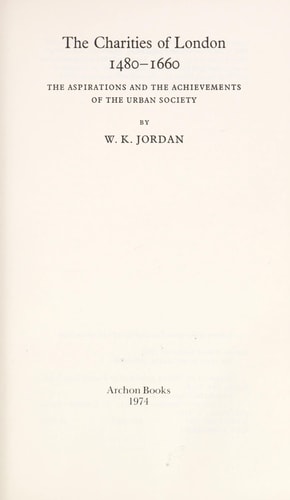
The Charities of London, 1480-1660: The Aspirations and the Achievements of the Urban Society
0
0
As an Amazon Associate and affiliate partner, Menrva Books earns from qualifying purchases. Learn more
Author Description
The first volume of this work, published in 1959, under the title Philanthropy in an England, 1480-1660, was an essay commenting on evidence drawn from ten English counties which together comprised something like a third of the land mass of the realm, about a third of the population in 1600, and perhaps half of the wealth of England in the age with which we are concerned. An effort was made to assess the social problems of the sixteenth and seventeenth centuries and to describe the nature of the problem of poverty in this era and the heroic measures which men took to deal with its control, if not its cure. Though remedial legislation was adopted, it was our conclusion that men of the age reposed their principal confidence in private charity, gathered by their instrumentality of the charitable trust into large large and disciplined aggregates of wealth with which formidably effective social institutions could be funded and endowed, as they undertook to relieve widespread and degrading poverty and to secure its prevention by a vast enlargement of the ambit of social and economic opportunity.
Menrva's Summary
THE THESIS
This work investigates the extent to which private charitable trusts, rather than state legislation, functioned as the primary mechanism for addressing poverty and social welfare in England between 1480 and 1660. W. K. Jordan, a noted historian of the period, utilizes extensive archival data from ten English counties to map the flow of private wealth into social institutions. He argues that the era was defined by a shift toward disciplined, endowed aggregates of capital intended to provide both immediate relief for the poor and long-term expansion of economic opportunity. By analyzing the motivations and outcomes of these donors, the study provides a comprehensive view of how urban society attempted to manage the social upheavals of the sixteenth and seventeenth centuries.
THE SCOPE MAP
What You Will Find
- Quantitative analysis of charitable endowments across ten representative English counties.
- Examination of the transition from medieval almsgiving to structured, institutionalized philanthropy.
- Assessment of the efficacy of private trusts in mitigating the systemic poverty of the era.
- Historical context regarding the relationship between remedial state legislation and private social investment.
THE AUTHORITY PERSPECTIVE
This text is regarded as a foundational study in the economic and social history of early modern England, noted for its rigorous use of primary source data to challenge traditional narratives about state-led welfare. The work remains a standard reference for scholars examining the intersection of private wealth, religious motivation, and social policy in the pre-industrial period.
Page Count:
463
Publication Date:
1974-01-01
Publisher:
Shoe String Pr Inc
ISBN-10:
0208014101
ISBN-13:
9780208014108
History
Great Britain
Economic History
Philanthropy
Social History
Community Tags
Similar Books