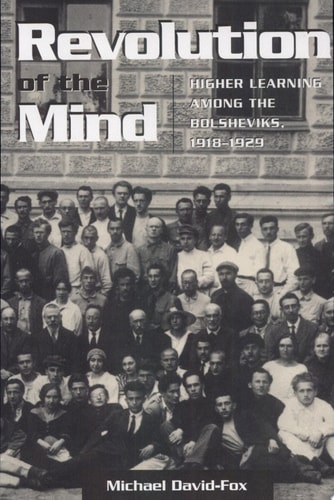
Revolution of the Mind: Higher Learning Among the Bolsheviks, 1918-1929
0
0
As an Amazon Associate and affiliate partner, Menrva Books earns from qualifying purchases. Learn more
Author Description
Using archival materials never previously accessible to Western scholars, Michael David-Fox analyzes Bolshevik Party educational and research initiatives in higher learning after 1917. His fresh consideration of the era of the New Economic Policy and cultural politics after the Revolution explains how new communist institutions rose to parallel and rival conventional higher learning from the Academy of Sciences to the universities. Beginning with the creation of the first party school by intellectuals on the island of Capri in 1909, David-Fox argues, the Bolshevik cultural project was tightly linked to party educational institutions. He provides the first account of the early history and politics of three major institutions founded after the Revolution: Sverdlov Communist University, where the quest to transform everyday life gripped the student movement; the Institute of Red Professors, where the Bolsheviks sought to train a new communist intellectual or red specialist; and the Communist Academy, headquarters for a planned, collectivist, proletarian science.
Menrva's Summary
THE THESIS
This book investigates the establishment and evolution of Bolshevik Party educational and research initiatives in higher learning following the 1917 Revolution. Michael David-Fox utilizes previously inaccessible archival materials to analyze how new communist institutions emerged to parallel and rival traditional academic structures like universities and the Academy of Sciences during the New Economic Policy era and the subsequent cultural politics. The narrative traces the Bolshevik cultural project's deep connection to party educational institutions, beginning with the 1909 founding of the first party school by intellectuals on Capri. The work provides the first comprehensive account of the early history and political dynamics of three key post-Revolutionary institutions: Sverdlov Communist University, the Institute of Red Professors, and the Communist Academy.
THE SCOPE MAP
- Analysis of Bolshevik Party educational and research initiatives in higher learning after 1917.
- Examination of the New Economic Policy era and cultural politics post-Revolution.
- Explanation of how new communist institutions paralleled and rivaled conventional higher learning.
- Historical account of the first party school founded by intellectuals on the island of Capri in 1909.
- Detailed history and politics of Sverdlov Communist University, focusing on student movements and the transformation of everyday life.
- Study of the Institute of Red Professors and its role in training a new communist intellectual class.
- Exploration of the Communist Academy as the headquarters for a planned, collectivist, proletarian science.
- Utilization of archival materials previously inaccessible to Western scholars.
THE AUTHORITY PERSPECTIVE
The book is regarded as a significant scholarly contribution, offering a detailed and well-researched account of the Bolshevik approach to higher education. Its reliance on newly accessible archival materials is frequently cited as a key strength, providing fresh perspectives on the development of communist educational institutions. The analysis of the interplay between party ideology and academic structures during a pivotal period in Soviet history is considered thorough. The work is recognized for its comprehensive coverage of key institutions and its exploration of the intellectual and political currents shaping Soviet academia.
Page Count:
298
Publication Date:
1997-01-01
Publisher:
Cornell University Press
ISBN-10:
080143128X
ISBN-13:
9780801431289
Non-Fiction
History
Higher Education
Russian History
Soviet Union
Intellectual History
Community Tags
Similar Books