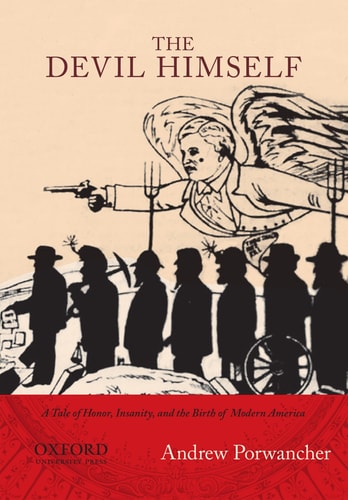
The Devil Himself: A Tale of Honor, Insanity, and the Birth of Modern America
0
0
As an Amazon Associate and affiliate partner, Menrva Books earns from qualifying purchases. Learn more
Author Description
Nicholas Dukes and Captain Adam Nutt were two men with much in common. Both were prominent members of Pennsylvanian society in the 1880s, both had studied law under the same mentor, and both shared an intimate connection to the beautiful Lizzie Nutt: Dukes was her debonair fiancé, Nutt her doting father. Yet Dukes soured on Lizzie during their engagement and resolved to rid himself of his betrothed. He penned a scandalous letter to Captain Nutt accusing Lizzie of sexual transgressions with no fewer than seven suitors, himself included. Such were her charms of seduction, Dukes claimed, that she "would disarm the devil himself." Nutt was not one to suffer lightly an affront to his family. He fired back, "I have always held that when a man invades the sanctity of a home, he takes his life in his hands, and under this code, I shall act." In their shared village of Uniontown, Nutt confronted Dukes in a duel that would lead to one man's death and the other's sensational murder trial. Using the Dukes-Nutt affair, the book explores the role of honor in a society hesitating at the threshold between past and future.The New Narratives in American History series aims to reimagine the craft of writing history by providing compelling tales told by scholars. These brief books rely on a sustained narrative to illuminate a larger historical theme or controversy.
Menrva's Summary
THE THESIS
This book investigates how the 1880s murder of Nicholas Dukes by Captain Adam Nutt serves as a microcosm for the shifting cultural standards of honor and legal accountability in post-Civil War America. Andrew Porwancher, a scholar of American history, utilizes this specific interpersonal conflict to examine the tension between traditional codes of personal vengeance and the emerging, more formal structures of the modern American legal system. By analyzing the trial and the social dynamics of Uniontown, Pennsylvania, the author argues that the case represents a pivotal moment where the nation struggled to reconcile its violent past with the requirements of a developing, rule-based society.
THE SCOPE MAP
What You Will Find
- A detailed account of the Dukes-Nutt affair, including the initial engagement, the scandalous letter, and the subsequent fatal confrontation.
- An analysis of the 'code of honor' prevalent in late 19th-century Pennsylvania society.
- A study of the legal proceedings and courtroom strategies employed during the murder trial.
Scope Limits
- The book does not provide a comprehensive history of the entire American legal system during the 1880s.
- The narrative is focused primarily on the specific events surrounding the Dukes-Nutt case rather than a broad survey of Pennsylvania state history.
THE AUTHORITY PERSPECTIVE
Historians and reviewers note that the text successfully bridges the gap between academic research and narrative storytelling, making it accessible to a general audience. Experts highlight this work as a concise, well-researched example of how microhistory can effectively illuminate broader societal transitions.
Page Count:
336
Publication Date:
2016-02-15
Publisher:
Oxford University Press
ISBN-10:
0190210788
ISBN-13:
9780190210786
History
True Crime
Biography
Trials Murder
Legal History
19th Century
American History
Community Tags
Similar Books