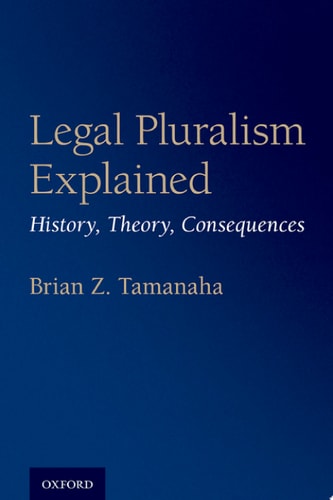
Legal Pluralism Explained: History, Theory, Consequences
0
0
As an Amazon Associate and affiliate partner, Menrva Books earns from qualifying purchases. Learn more
Author Description
Legal pluralism involves the coexistence of multiple forms of law. This involves state law, international law, transnational law, customary law, religious law, indigenous law, and the law of distinct ethnic or cultural communities. Legal pluralism is a subject of discussion today in legal anthropology, legal sociology, legal history, postcolonial legal studies, women's rights and human rights, comparative law, international law, transnational law, European Union law, jurisprudence, and law and development scholarship.A great deal of confusion and theoretical disagreement surrounds discussions of legal pluralism—which this book aims to clarify and help resolve. Drawing on historical and contemporary studies—including the Medieval period, the Ottoman Empire, postcolonial societies, Native peoples, Jewish and Islamic law, Western state legal systems, transnational law, as well as others—it shows that the dominant image of the state with a unified legal system exercising a monopoly over law is, and has always been, false and misleading. State legal systems are internally pluralistic in various ways and multiple manifestations of law coexist in every society. This book explains the underlying reasons for and sources of legal pluralism, identifies its various consequences, uncovers its conceptual and normative implications, and resolves current theoretical disputes in ways that are useful for social scientists, theorists, jurists, and law and development scholars and practitioners.
Menrva's Summary
THE THESIS
This book investigates the core question of how legal pluralism functions as a reality in societies despite the persistent, dominant myth of the state as a unified legal monopoly. Brian Z. Tamanaha, a scholar of jurisprudence and legal theory, utilizes a vast array of historical and contemporary case studies to dismantle the traditional state-centric view of law. By examining diverse systems—ranging from the Medieval period and the Ottoman Empire to modern transnational and indigenous legal frameworks—he provides a comprehensive theoretical framework that clarifies the nature, sources, and consequences of pluralistic legal environments.
THE SCOPE MAP
What You Will Find
- Historical analysis of legal systems in the Medieval period and the Ottoman Empire
- Comparative studies of customary, religious, indigenous, and state-based legal frameworks
- Theoretical resolution of current academic disputes regarding the definition of law
- Examination of postcolonial legal structures and transnational law
Scope Limits
- The text does not provide a practical handbook for navigating specific local legal disputes
- It does not offer an exhaustive catalog of every existing indigenous legal system globally
THE AUTHORITY PERSPECTIVE
Scholars and jurists frequently identify this work as a critical intervention in legal theory that successfully synthesizes disparate fields like anthropology and sociology. Readers often note the academic density of the prose, which is intended for advanced students and practitioners seeking to resolve long-standing conceptual confusion in the field.
Page Count:
227
Publication Date:
2021-01-01
Publisher:
Oxford University Press
ISBN-10:
0190861584
ISBN-13:
9780190861582
Professional Career & Trade
Legal Theory
Law
Jurisprudence
Legal Anthropology
Community Tags
Similar Books