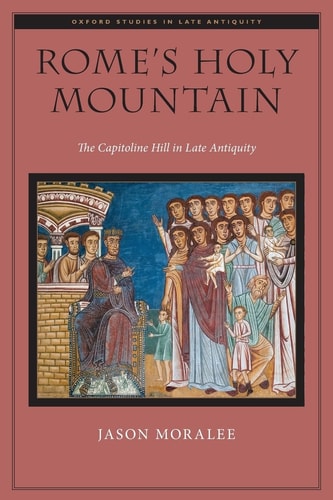
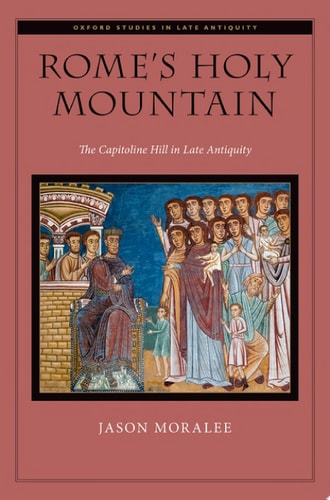
Rome's Holy Mountain: The Capitoline Hill in Late Antiquity
0
0
As an Amazon Associate and affiliate partner, Menrva Books earns from qualifying purchases. Learn more
Author Description
Rome's Capitoline Hill was the smallest of the Seven Hills of Rome. Yet in the long history of the Roman state it was the empire's holy mountain. The hill was the setting of many of Rome's most beloved stories, involving Aeneas, Romulus, Tarpeia, and Manlius. It also held significant monuments, including the Temple of Jupiter Optimus Maximus, a location that marked the spot where Jupiter made the hill his earthly home in the age before humanity. This is the first book that follows the history of the Capitoline Hill into late antiquity and the early middle ages, asking what happened to a holy mountain as the empire that deemed it thus became a Christian republic. This is not a history of the hill's tonnage of marble and gold bedecked monuments, but rather an investigation into how the hill was used, imagined, and known from the third to the seventh centuries CE. During this time, the imperial triumph and other processions to the top of the hill were no longer enacted. But the hill persisted as a densely populated urban zone and continued to supply a bridge to fragmented memories of an increasingly remote past through its toponyms. This book is also about a series of Christian engagements with the Capitoline Hill's different registers of memory, the transmission and dissection of anecdotes, and the invention of alternate understandings of the hill's role in Roman history. What lingered long after the state's disintegration in the fifth century were the hill's associations with the raw power of Rome's empire.
Menrva's Summary
THE THESIS
This book investigates how the Capitoline Hill, once the sacred center of the Roman Empire, was reimagined and utilized during the transition from pagan antiquity to the Christian Middle Ages. Jason Moralee, a scholar of late antiquity, examines the shift in the hill's cultural and religious significance between the third and seventh centuries CE. By analyzing literary sources, toponyms, and urban development, the author argues that the site remained a potent symbol of imperial power even as its original ritual functions vanished.
THE SCOPE MAP
What You Will Find
- Analysis of the Capitoline Hill from the third to the seventh centuries CE.
- Examination of Christian engagements with pagan historical memory.
- Investigation into the persistence of Roman imperial identity through urban space.
Scope Limits
- The text does not focus on the architectural history or physical construction of the hill's monuments.
- It does not provide a comprehensive archaeological survey of the site's physical remains.
THE AUTHORITY PERSPECTIVE
Scholars recognize this work as a significant contribution to the study of Roman cultural memory and the transformation of urban landscapes in late antiquity. Readers frequently note the academic rigor and the author's ability to synthesize complex historical shifts into a coherent narrative about the endurance of symbolic spaces.
Page Count:
305
Publication Date:
2017-01-01
Publisher:
Oxford University Press
ISBN-10:
0190865741
ISBN-13:
9780190865740
History
Religion
Cultural History
Ancient History
Ancient - Rome
Italy history
World Civilization
Late Antiquity
Urban History
Community Tags
Similar Books