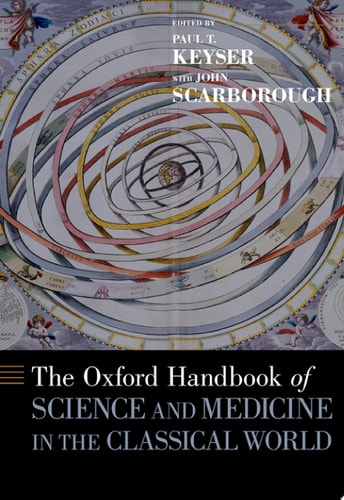
The Oxford Handbook of Science and Medicine in the Classical World
0
0
As an Amazon Associate and affiliate partner, Menrva Books earns from qualifying purchases. Learn more
Author Description
With A Focus On Science In The Ancient Societies Of Greece And Rome, Including Glimpses Into Egypt, Mesopotamia, India And China, The Oxford Handbook Of Science And Medicine In The Classical World Offers An In Depth Synthesis Of Science And Medicine Circa 650 Bce To 650 Ce. The Handbook Comprises Five Sections, Each With A Specific Focus On Ancient Science And Medicine. The Second Section Covers The Early Greek Era, Up Through Plato And The Mid-fourth Century Bce. The Third Section Covers The Long Hellenistic Era, From Aristotle Through The End Of The Roman Republic, Acknowledging That The Political Shift Does Not Mark A Sharp Intellectual Break. The Fourth Section Covers The Roman Era From The Late Republic Through The Transition To Late Antiquity. The Final Section Covers The Era Of Late Antiquity, Including The Early Byzantine Centuries. The Handbook Provides Through Each Of Its Approximately Four Dozen Essays, A Synthesis And Synopsis Of The Concepts And Models Of The Various Ancient Natural Sciences, Covering The Early Greek Era Through The Fall Of The Roman Republic, Including Essays That Explore Topics Such As Music Theory, Ancient Philosophers, Astrology, And Alchemy. The Oxford Handbook Of Science And Medicine In The Classical World Guides The Reader To Further Exploration Of The Concepts And Models Of The Ancient Sciences, How They Evolved And Changed Over Time, And How They Relate To One Another And To Their Antecedents. There Are A Total Of Four Dozen Or So Topical Essays In The Five Sections, Each Of Which Takes As Its Focus The Primary Texts, Explaining What Is Now Known As Well As Indicating What Future Generations Of Scholars May Come To Know. Contributors Suggest The Ranges Of Scholarly Disagreements And Have Been Free To Advocate Their Own Positions. Readers Are Led Into Further Literature (both Primary And Secondary) Through The Comprehensive And Extensive Bibliographies Provided With Each Chapter.
Menrva's Summary
THE THESIS
This volume investigates the development, conceptual frameworks, and practical applications of science and medicine within the civilizations of Greece and Rome from 650 BCE to 650 CE. Paul T. Keyser and John Scarborough, both established scholars in the history of ancient science, curate a collection of approximately four dozen essays that synthesize primary source evidence. The work argues that ancient intellectual traditions were fluid, evolving across political shifts from the early Greek era through the Byzantine transition, and provides a structured analysis of how these disciplines related to one another.
THE SCOPE MAP
What You Will Find
- Chronological analysis spanning the early Greek era, the Hellenistic period, the Roman Republic, and Late Antiquity.
- Topical examinations of specialized fields including music theory, astrology, alchemy, and natural philosophy.
- Extensive bibliographies accompanying each chapter for further research into primary and secondary literature.
Scope Limits
- The text focuses primarily on the Greco-Roman sphere, with only limited comparative glimpses into Egyptian, Mesopotamian, Indian, and Chinese traditions.
- It does not provide a singular, unified narrative history, but rather a collection of independent scholarly essays.
THE AUTHORITY PERSPECTIVE
Scholars and students frequently cite this handbook as a foundational reference for understanding the complexities of ancient scientific thought. Readers often note the academic density of the prose, which is designed for those already familiar with the primary texts and historical context of the period.
Page Count:
1200
Publication Date:
2018-01-01
Publisher:
Oxford University Press
ISBN-10:
0190878827
ISBN-13:
9780190878825
History
Science
Ancient History
Medicine
Philosophy of
Community Tags
Similar Books














