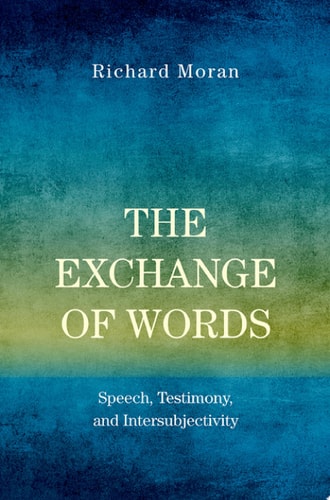
The Exchange of Words
0
0
As an Amazon Associate and affiliate partner, Menrva Books earns from qualifying purchases. Learn more
Author Description
The Capacity To Speak Is Not Only The Ability To Pronounce Words, But The Socially-recognized Capacity To Make One's Words Count In Various Ways. We Rely On This Capacity Whenever We Tell Another Person Something And Expect To Be Believed, And What We Learn From Others In This Way Is The Basis For Most Of What We Take Ourselves To Know About The World. In The Exchange Of Words, Richard Moran Provides A Philosophical Exploration Of Human Testimony As A Form Of Intersubjective Understanding In Which Speakers Communicate By Making Themselves Accountable For The Truth Of What They Say. The Book Brings Together Themes From Literature, Philosophy Of Language, Moral Psychology, Action Theory, And Epistemology, For A New Approach To This Fundamental Human Phenomenon. The Account Developed Here Starts From The Difference Between What May Be Revealed In One's Speech (like A Regional Accent) And What We Explicitly Claim And Make Ourselves Answerable For. Some Prominent Themes Include: The Meaning Of Sincerity In Speech, The Nature Of Mutuality And How It Differs From 'mind-reading', The Interplay Between The First-person And The Second-person Perspectives In Conversation, And The Nature Of The Speech Act Of Telling And Related Illocutions As Developed By Philosophers Such As J. L. Austin And Paul Grice. Everyday Dialogue Is The Locus Of A Kind Of Intersubjective Understanding That Is Distinctive Of The Transmission Of Reasons In Human Testimony, And The Exchange Of Words Is An Original And Integrated Account Of This Basic Way Of Being Informative To And In Touch With One Another.
Menrva's Summary
THE THESIS
The book investigates the philosophical nature of human testimony, specifically how the capacity to speak functions as a socially recognized mechanism for establishing knowledge and intersubjective understanding. Richard Moran, a noted philosopher, synthesizes concepts from action theory, linguistics, and moral psychology to argue that testimony is not merely the transmission of information, but a process where speakers make themselves accountable for the truth of their claims. By distinguishing between involuntary speech indicators and explicit assertions, the author constructs a framework for understanding how dialogue serves as the primary locus for shared human knowledge.
THE SCOPE MAP
What You Will Find
- Analysis of the speech act of telling and related illocutions.
- Examination of the interplay between first-person and second-person perspectives.
- Philosophical inquiry into the meaning of sincerity and mutuality in conversation.
- Integration of theories from J.L. Austin and Paul Grice.
Scope Limits
- The text does not focus on the biological or neurological mechanisms of speech production.
- It does not provide a sociological study of regional dialects or linguistic evolution.
THE AUTHORITY PERSPECTIVE
Scholars and students of philosophy frequently cite this work as a rigorous contribution to the epistemology of testimony. Readers often note the dense, analytical nature of the prose, which requires a foundational understanding of speech act theory and moral psychology to fully grasp the author's arguments.
Page Count:
288
Publication Date:
2018-01-01
Publisher:
Oxford University Press
ISBN-10:
0190873337
ISBN-13:
9780190873332
Philosophy
Epistemology
Communication Studies
Philosophy of
Community Tags
Similar Books