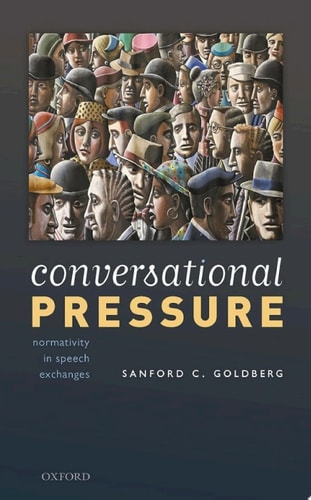
Conversational Pressure: Normativity in Speech Exchanges
0
0
As an Amazon Associate and affiliate partner, Menrva Books earns from qualifying purchases. Learn more
Author Description
In the course of conversation, we exert implicit pressures on both ourselves and others. These forms of conversational pressure are many and far from uniform, so much so that it is unclear whether they constitute a single cohesive class. In this book Sanford C. Goldberg explores the source, nature, and scope of the normative expectations we have of one another as we engage in conversation that are generated by the performance of speech acts themselves. In doing so he examines two fundamental types of expectation -- epistemic and interpersonal. It is through normative expectations of these types that we aim to hold one another to standards of proper conversational conduct. This line of argument is pursued in connection with such topics as the normative significance of acts of address, the epistemic costs of politeness, the bearing of epistemic injustice on the epistemology of testimony, the normative pressure friendship exerts on belief, the nature of epistemic trust, the significance of conversational silence, and the various evils of silencing. By approaching these matters in terms of the normative expectations to which conversational participants are entitled, Goldberg aims to offer a unified account of the various pressures that are exerted in the course of a speech exchange.
Menrva's Summary
THE THESIS
This book investigates the source, nature, and scope of the normative expectations generated by speech acts during human conversation. Sanford C. Goldberg, a philosopher specializing in epistemology and the philosophy of language, utilizes a framework of normative expectations to analyze how participants hold one another to standards of conduct. He argues that these pressures, while diverse, can be categorized into epistemic and interpersonal types, providing a unified account of the social and cognitive obligations inherent in speech exchanges.
THE SCOPE MAP
What You Will Find
- Analysis of epistemic and interpersonal normative expectations
- Examination of the normative significance of acts of address
- Discussion on the epistemic costs of politeness and the nature of epistemic trust
- Exploration of epistemic injustice and the ethics of silencing
- Investigation into the influence of friendship on belief formation
Scope Limits
- The text does not provide a comprehensive manual for social etiquette or conversational coaching
- It does not cover the biological or neurological mechanisms of speech production
THE AUTHORITY PERSPECTIVE
Experts in philosophy and linguistics recognize this work as a rigorous contribution to the study of social epistemology and the ethics of communication. Readers frequently note the academic density of the prose, which is intended for scholars and advanced students of philosophy.
Page Count:
265
Publication Date:
2020-01-01
Publisher:
OUP Oxford
ISBN-10:
0192598392
ISBN-13:
9780192598394
Philosophy
Epistemology
Social Philosophy
Linguistics
Communication Studies
Community Tags
Similar Books