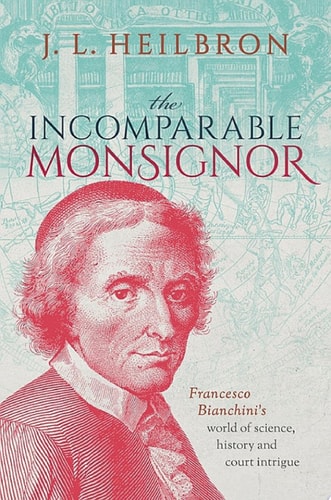
The Incomparable Monsignor: Francesco Bianchini's World of Science, History, and Court Intrigue
0
0
As an Amazon Associate and affiliate partner, Menrva Books earns from qualifying purchases. Learn more
Author Description
Through Francesco Bianchini, the 'greatest Italian of his time' this book explores the exciting meeting of science, history, and politics in early modern Europe. Born in a time where entry into the church granted power, privilege, and access to the most exciting ideas of his time, the magnificent Monsignor Francesco Bianchini was an accomplished player in the political, scientific, and historical arenas of early modern Europe. Among his accomplishments were writing a universal history from the creation to the fall of Assyria; discovering, excavating, and interpreting ancient buildings; and designing a papal collection of antiquities that was later partially realized in the Vatican museums. He was also responsible for confirming and publicizing Newton's theories of light and color; discovering several comets; and building the most beautiful and exact heliometer in the world in the basilica of Santa Maria degli Angeli in Rome. Bianchini's international reputation earned him election to the Académie royale des sciences of Paris and the Royal Society of London. As a trusted servant of Pope Clement XI, he helped to execute the difficult balancing act the papacy practiced during the War of the Spanish Succession, which pitted Britain, the Dutch Republic, and the Habsburg Empire against France and Spain. One of his assignments also resulted in attachment to the cause and person of the Old Pretender, James III, the Stuart claimant to the thrones of England, Scotland, and Ireland. Through the career of this eminent and adept diplomat, astronomer, archaeologist, and historian, J. L. Heilbron introduces a world of learning and discovery, Church and State, and politics and power.
Menrva's Summary
THE THESIS
This biography investigates how Francesco Bianchini, a polymath and cleric, navigated the intersection of scientific advancement, historical scholarship, and high-stakes diplomacy in early modern Europe. Author J. L. Heilbron, a distinguished historian of science, utilizes archival records and Bianchini’s own extensive correspondence to frame his life as a microcosm of the intellectual and political tensions of the era. The work argues that Bianchini’s multifaceted career was not merely a collection of disparate interests but a cohesive effort to reconcile traditional ecclesiastical authority with the burgeoning Enlightenment pursuit of empirical knowledge.
THE SCOPE MAP
What You Will Find
- Detailed accounts of Bianchini’s contributions to astronomy, including his work on comets and Newton’s theories.
- Analysis of his archaeological excavations and his role in the conceptualization of the Vatican museums.
- Examination of his diplomatic missions during the War of the Spanish Succession and his association with the Stuart claimant.
Scope Limits
- The text does not provide a comprehensive history of the War of the Spanish Succession beyond Bianchini’s specific involvement.
- It does not offer a technical manual for the construction of his heliometers or other scientific instruments.
THE AUTHORITY PERSPECTIVE
Scholars and historians of science frequently note the meticulous research and academic rigor Heilbron brings to this biographical study. Experts highlight this work as a significant contribution to understanding the intellectual climate of the Roman Curia during the late seventeenth and early eighteenth centuries.
Page Count:
337
Publication Date:
2022-01-01
Publisher:
OUP Oxford
ISBN-10:
0192670611
ISBN-13:
9780192670618
Biography
History
Archaeology
Earth Sciences
Science History
Italy history
Early Modern
Papal History
Community Tags
Similar Books