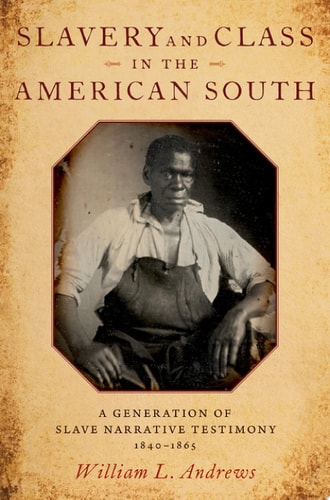
Slavery and Class in the American South
0
0
As an Amazon Associate and affiliate partner, Menrva Books earns from qualifying purchases. Learn more
Author Description
The distinction among slaves is as marked, as the classes of society are in any aristocratic community. Some refusing to associate with others whom they deem to be beneath them, in point of character, color, condition, or the superior importance of their respective masters. Henry Bibb, fugitive slave, editor, and antislavery activist, stated this in his Narrative of the Life and Adventures of Henry Bibb (1849). In William L. Andrews's magisterial study of an entire generation of slave narrators, more than 60 mid-nineteenth-century narratives reveal how work, family, skills, and connections made for social and economic differences among the enslaved of the South. Slave narrators disclosed class-based reasons for violence that broke out between impudent, gentleman, and lady slaves and their resentful mean masters. Andrews's far-reaching book shows that status and class played key roles in the self- and social awareness and in the processes of liberation portrayed in the narratives of the most celebrated fugitives from U.S. slavery, such as Frederick Douglass, Harriet Jacobs, William Wells Brown, and William and Ellen Craft. Slavery and Class in the American South explains why social and economic distinctions developed and how they functioned among the enslaved. Noting that the majority of the slave narrators came from the higher echelons of the enslaved, Andrews also pays close attention to the narratives that have received the least notice from scholars, those from the most exploited class, the field hands. By examining the lives of the most and least acclaimed heroes and heroines of the slave narrative, Andrews shows how the dividing edge of social class cut two ways, sometimes separating upper and lower strata of slaves to their enslavers' advantage, but at other times fueling pride, aspiration, and a sense of just deserts among some of the enslaved that could be satisfied by nothing less than complete freedom.
Menrva's Summary
THE THESIS
This work investigates how internal social and economic stratification among enslaved people in the American South influenced their self-awareness, social dynamics, and pursuit of liberation. William L. Andrews, a scholar of African American literature, utilizes a corpus of over 60 mid-nineteenth-century slave narratives to argue that class distinctions were not merely imposed by enslavers but were actively negotiated by the enslaved themselves. By analyzing the experiences of both elite house servants and exploited field hands, the author demonstrates how these hierarchies shaped the resistance strategies and aspirations of those seeking freedom.
THE SCOPE MAP
What You Will Find
- Analysis of over 60 mid-nineteenth-century slave narratives.
- Examination of social stratification based on labor, family, and master status.
- Comparative study of elite enslaved individuals versus field hands.
- Discussion of how class awareness fueled or hindered collective resistance.
Scope Limits
- The study focuses primarily on the perspectives provided by published narratives rather than archaeological or purely statistical data.
- It does not attempt to provide a comprehensive economic history of the entire antebellum South outside the context of the enslaved population's internal social structure.
THE AUTHORITY PERSPECTIVE
Scholars recognize this text as a significant contribution to the study of slave narratives, noting its ability to synthesize literary analysis with social history. Readers frequently highlight the author's balanced approach in giving voice to both the celebrated figures of the abolitionist movement and the often-overlooked field laborers.
Page Count:
480
Publication Date:
2019-01-01
Publisher:
Oxford University Press
ISBN-10:
0190908394
ISBN-13:
9780190908393
History
American History
Slavery
African American
Sociology
Social History
Community Tags
Similar Books