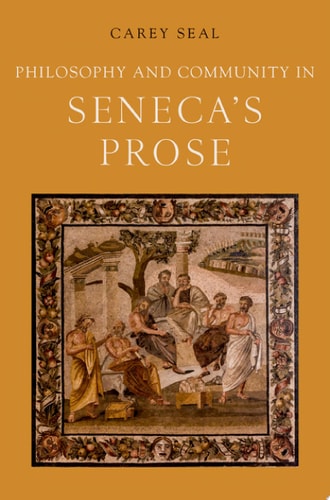
Philosophy and Community in Seneca's Prose
0
0
As an Amazon Associate and affiliate partner, Menrva Books earns from qualifying purchases. Learn more
Author Description
The Roman philosopher Seneca addressed himself to the question of how we ought to live in letters and treatises that have engaged the attention of readers from his own day to the present. A committed, if critical and eccentric, adherent of Stoicism, he gives us a set of reflections on the good life that are rich both in philosophical subtlety and in vivid engagement with day-to-day life in ancient Rome. Philosophy and Community in Seneca's Prose proposes a new understanding of the relationship between these two facets of Seneca's achievement, examining how he balances the Socratic imperative to subject one's life to rational scrutiny, on the one hand, with the claims of Roman moral tradition on the other. Carey Seal argues that we should think of Seneca neither as a spokesman for Stoicism who seizes opportunistically upon the data of Roman social life to make his case, nor as an expositor of the inherited values of the Roman elite in the language of Stoic philosophy. Rather, Seneca should be understood as someone intensely interested in the question of philosophy's social entanglements and presuppositions. Seneca's use of Roman politics and of the institution of slavery in elaborating his ideal of a life guided by reason is carefully examined in the book.
Menrva's Summary
THE THESIS
This book investigates how Seneca the Younger navigates the tension between universal Stoic rationalism and the specific social and political constraints of Roman life. Carey Seal, a scholar of classical literature and philosophy, utilizes a close reading of Seneca's letters and treatises to challenge traditional interpretations of his work. The author argues that Seneca does not merely apply Stoic dogma to Roman life, but rather actively explores the complex, often contradictory, relationship between philosophical ideals and the social structures of his time.
THE SCOPE MAP
What You Will Find
- Analysis of Seneca's letters and treatises as primary philosophical texts
- Examination of the intersection between Socratic rationalism and Roman moral tradition
- Investigation into Seneca's treatment of Roman political institutions and the practice of slavery
- A framework for understanding Seneca's social philosophy as an integrated project
Scope Limits
- The text does not provide a comprehensive biography of Seneca's life
- It does not attempt to reconcile all inconsistencies within the broader Stoic school of thought
THE AUTHORITY PERSPECTIVE
Scholars view this work as a significant contribution to the study of Roman Stoicism, particularly for its nuanced approach to Seneca's social commentary. Readers frequently note the academic density of the prose, which is intended for those with a background in classical philosophy or Roman history.
Page Count:
221
Publication Date:
2021-01-01
Publisher:
Oxford University Press
ISBN-10:
0190905859
ISBN-13:
9780190905859
History
Philosophy
Roman History
World Civilization
World Languages
Latin
History & Surveys
Ancient History
stoicism
Community Tags
Similar Books