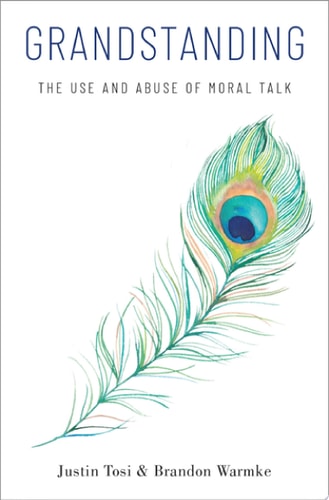
Grandstanding: The Use and Abuse of Moral Talk
0
0
As an Amazon Associate and affiliate partner, Menrva Books earns from qualifying purchases. Learn more
Author Description
We are all guilty of it. We call people terrible names in conversation or online. We vilify those with whom we disagree, and make bolder claims than we could defend. We want to be seen as taking the moral high ground not just to make a point, or move a debate forward, but to look a certain way--incensed, or compassionate, or committed to a cause. We exaggerate. In other words, we grandstand. Nowhere is this more evident than in public discourse today, and especially as it plays out across the internet. To philosophers Justin Tosi and Brandon Warmke, who have written extensively about moral grandstanding, such one-upmanship is not just annoying, but dangerous. As politics gets more and more polarized, people on both sides of the spectrum move further and further apart when they let grandstanding get in the way of engaging one another. The pollution of our most urgent conversations with self-interest damages the very causes they are meant to forward. Drawing from work in psychology, economics, and political science, and along with contemporary examples spanning the political spectrum, the authors dive deeply into why and how we grandstand. Using the analytic tools of psychology and moral philosophy, they explain what drives us to behave in this way, and what we stand to lose by taking it too far. Most importantly, they show how, by avoiding grandstanding, we can re-build a public square worth participating in.
Menrva's Summary
THE THESIS
This book investigates the phenomenon of moral grandstanding, arguing that the performative use of moral language in public discourse undermines genuine communication and damages the causes it purports to support. Authors Justin Tosi and Brandon Warmke, both philosophers, utilize a multidisciplinary framework to analyze why individuals prioritize social status over substantive debate. By synthesizing research from psychology, economics, and political science, they demonstrate how the pursuit of moral prestige creates polarization and erodes the integrity of the public square.
THE SCOPE MAP
What You Will Find
- Analysis of the psychological drivers behind performative moral signaling.
- Economic and political science perspectives on the incentives for public moral posturing.
- Strategies for fostering more productive and authentic public discourse.
Scope Limits
- The text does not provide a comprehensive history of political rhetoric.
- It does not offer a prescriptive guide for solving all forms of political polarization.
THE AUTHORITY PERSPECTIVE
Experts and readers frequently note the clarity of the authors' philosophical arguments and their ability to apply academic concepts to contemporary internet culture. The text is widely regarded as a foundational resource for understanding the mechanics of modern moral discourse.
Page Count:
242
Publication Date:
2020-01-01
Publisher:
Oxford University Press
ISBN-10:
0190900172
ISBN-13:
9780190900175
Philosophy
Sociology
Communication
Ethics
Community Tags
Similar Books