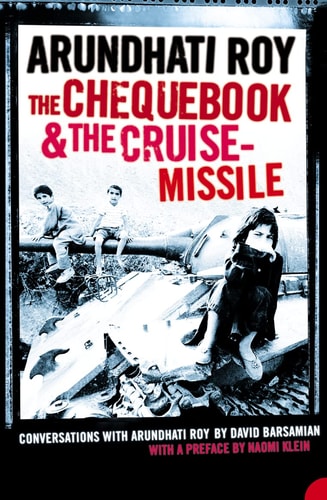
The Chequebook and the Cruise Missile: Conversations with Arundhati Roy
0
0
As an Amazon Associate and affiliate partner, Menrva Books earns from qualifying purchases. Learn more
Author Description
As a novelist, Arundhati Roy is known for her lush language and intricate structure. As a political essayist, her prose is searching and fierce. All of these qualities shine through in the interviews collected by David Barsamian for The Chequebook and the Cruise Missile, recorded between 2001 and 2003. Whether discussing her childhood or the problems of translation in a multilingual society, Roy and Barsamian, the producer and host of Alternative Radio, engage in a lively and accessible manner. Speaking candidly and casually, Roy describes her participation in a demonstration against the Indian dam program as "absolutely fantastic". She jokes that her Supreme Court charge for "corrupting public morality" -- in the case of her novel The God of Small Things -- should have been changed to "further corrupting public morality." She calls on her training as an architect to explain what she means by the "physics of power". Like a house of cards, she argues that "unfettered power!cannot go berserk like this and expect to hold it all together." Roy has been acclaimed for her courage (Salman Rushdie) and her eloquence (Kirkus Reviews), and her writing has been described as "a banquet for the senses" (Newsweek). She has found a readership among fiction enthusiasts and political activists. The Chequebook and the Cruise Missile captures Roy speaking one-on-one to her audience, revealing her intense and wide-ranging intellect, her very personal voice, and her opinion on momentous political events. Arundhati Roy's novel The God of Small Things was awarded the Booker Prize in 1997. She is the recipient of the 2002 Lannan Foundation Prize for Cultural Freedom.
Menrva's Summary
THE THESIS
This collection of interviews investigates the intersection of global political power, corporate influence, and individual resistance through the lens of Arundhati Roy's activist perspective. David Barsamian, a veteran radio producer, facilitates these conversations to extract Roy's analysis on topics ranging from the Indian dam projects to the broader implications of neoliberalism. The text functions as a bridge between Roy's literary sensibilities and her role as a public intellectual, utilizing her background in architecture to frame complex power dynamics as structural, fragile systems. By documenting her candid responses between 2001 and 2003, the book provides a primary source record of her evolving political philosophy during a period of intense global instability.
THE SCOPE MAP
What You Will Find
- Transcripts of interviews conducted between 2001 and 2003 regarding political and social issues.
- Analysis of the 'physics of power' and the structural instability of unchecked global influence.
- First-hand accounts of Roy's participation in Indian grassroots protests and legal challenges.
- Discussions on the role of language, translation, and the responsibility of the writer in a multilingual society.
THE AUTHORITY PERSPECTIVE
The text serves as an accessible entry point into Roy's political thought, offering a conversational counterpoint to her more formal essays. The framing suggests a dense, intellectually rigorous dialogue that highlights the author's ability to synthesize complex geopolitical events into personal, urgent narratives.
Page Count:
192
Publication Date:
2004-01-01
Publisher:
HarperPerennial
ISBN-10:
0007194188
ISBN-13:
9780007194186
Politics
Non-Fiction
English
Interviews
Globalization
Literary Criticism
Social Commentary
India
C & C
Community Tags
Similar Books