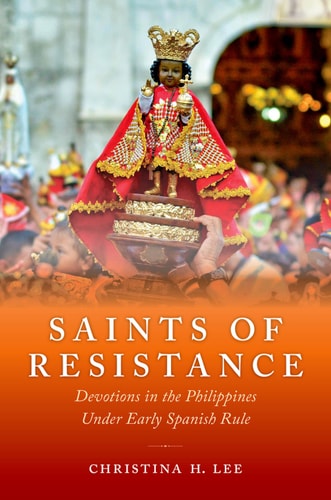
Saints of Resistance: Devotions in the Philippines under Early Spanish Rule
0
0
As an Amazon Associate and affiliate partner, Menrva Books earns from qualifying purchases. Learn more
Author Description
Eighty percent of Filipinos (about 80 million people) identify with the Catholic faith. Visitors to the Philippines might find it surprising that images of Catholic saints, the Child Christ, and the Virgin Mary can be seen in all kinds of public and private spaces throughout this Asian country, such as in restaurants, shopping malls, pasted to walls, painted on buses, and of course, in-home altars. Many of these saints bear Spanish names and their legends almost always date to the period of Spanish colonialism.Saints of Resistance: Devotions in the Philippines under Early Spanish Rule explores why, in spite of their fraught history with Spanish colonialism (which ended in 1898), Filipinos have staunchly held on to the faith in their saints. This is the first scholarly study to focus on the dynamic life of saints and their devotees in the Spanish Philippines, from the sixteenth through the early part of the eighteenth century. The book offers an in-depth analysis of the origins and development of the beliefs and rituals surrounding some of the most popular saints in the Philippines, namely, Santo Niño de Cebu, Our Lady of Caysasay, Our Lady of La Naval, and Our Lady of Antipolo. Christina Lee recovers the voices of colonized Philippine subjects as well as those of Spaniards who, through the veneration of miraculous saints, projected and relieved their grievances, anxieties, and histories of communal suffering. Based on critical readings of primary sources, the book traces how individuals and their communities often refashioned iconographic devotions to the Holy Child and to the Virgin Mary by introducing non-Catholic elements derived from pre-Hispanic, animistic, and Chinese traditions. Ultimately, the book reveals how Philippine natives, Chinese migrants, and Spaniards reshaped the imported devotions as expressions of dissidence, resistance, and survival.
Menrva's Summary
THE THESIS
This work investigates how the veneration of Catholic saints in the early Spanish Philippines functioned as a complex mechanism for cultural survival and resistance against colonial hegemony. Christina H. Lee, a scholar of early modern Spanish and colonial studies, utilizes a rigorous analysis of primary sources to examine the intersection of religious devotion and social identity. She argues that the adoption of Catholic iconography by indigenous Filipinos, Chinese migrants, and Spanish settlers was not merely an act of conversion, but a strategic refashioning of faith to express communal grievances and historical trauma.
THE SCOPE MAP
What You Will Find
- Analysis of the cults surrounding Santo Niño de Cebu, Our Lady of Caysasay, Our Lady of La Naval, and Our Lady of Antipolo.
- Examination of the syncretic integration of pre-Hispanic, animistic, and Chinese traditions into Catholic practice.
- Historical documentation spanning the sixteenth through the early eighteenth centuries.
Scope Limits
- The study focuses primarily on the early colonial period and does not extend its analysis to the late nineteenth-century revolutionary era or modern contemporary practices.
THE AUTHORITY PERSPECTIVE
Scholars recognize this text as a significant contribution to the study of colonial religious history, particularly for its focus on the agency of colonized subjects. Readers frequently note the academic density of the prose, which provides a nuanced look at how religious symbols were repurposed within a colonial framework.
Page Count:
209
Publication Date:
2021-01-01
Publisher:
Oxford University Press
ISBN-10:
0190916168
ISBN-13:
9780190916169
Religion
History
Colonialism
Sociology of Religion
Asian History
Philippines
Community Tags
Similar Books