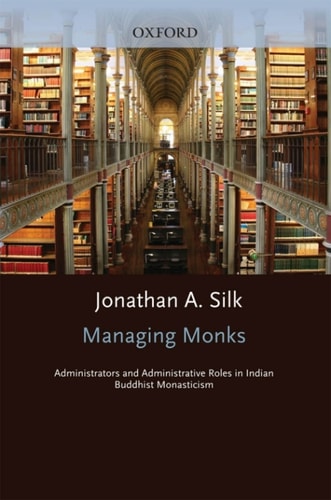
Managing Monks: Administrators and Administrative Roles in Indian Buddhist Monasticism
0
0
As an Amazon Associate and affiliate partner, Menrva Books earns from qualifying purchases. Learn more
Author Description
The paradigmatic Buddhist is the monk. It is well known that ideally Buddhist monks are expected to meditate and study -- to engage in religious practice. The institutional structure which makes this concentration on spiritual cultivation possible is the monastery. But as a bureaucratic institution, the monastery requires administrators to organize and manage its functions, to prepare quiet spots for meditation, to arrange audiences for sermons, or simply to make sure food, rooms, and bedding are provided. The valuations placed on such organizational roles were, however, a subject of considerable controversy among Indian Buddhist writers, with some considering them significantly less praiseworthy than meditative concentration or teaching and study, while others more highly appreciated their importance. Managing Monks, as the first major study of the administrative offices of Indian Buddhist monasticism and of those who hold them, explores literary sources, inscriptions and other materials in Sanskrit, Pali, Tibetan, and Chinese in order to explore this tension and paint a picture of the internal workings of the Buddhist monastic institution in India, highlighting the ambivalent and sometimes contradictory attitudes toward administrators revealed in various sources.
Menrva's Summary
THE THESIS
This book investigates the historical tension between the ideal of the meditative Buddhist monk and the pragmatic necessity of administrative roles within Indian monastic institutions. Jonathan A. Silk, a scholar of Buddhist studies, utilizes a diverse array of primary sources to examine how these bureaucratic functions were perceived by monastic communities. By analyzing the conflicting valuations of administrative labor versus spiritual practice, the author constructs a framework for understanding the internal governance of Indian Buddhist monasteries.
THE SCOPE MAP
What You Will Find
- Analysis of administrative offices and roles within Indian Buddhist monasticism.
- Examination of literary sources, inscriptions, and historical documents in Sanskrit, Pali, Tibetan, and Chinese.
- Exploration of the ideological conflict between spiritual cultivation and institutional management.
- Evidence regarding the social and religious status of monastic administrators in ancient India.
THE AUTHORITY PERSPECTIVE
Experts recognize this work as a foundational study on the institutional history of Indian Buddhism, noting the author's rigorous engagement with multilingual primary sources. Readers frequently highlight the text's academic density and its contribution to understanding the practical realities of monastic life.
Page Count:
360
Publication Date:
2008-01-01
Publisher:
Oxford University Press
ISBN-10:
0198043813
ISBN-13:
9780198043812
Religion
History
Asian History
Asian Studies
Buddhism india
Buddhism
Sociology of Religion
Monasticism
Community Tags
Similar Books