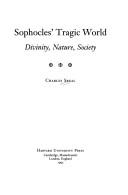
Sophocles' Tragic World
0
0
As an Amazon Associate and affiliate partner, Menrva Books earns from qualifying purchases. Learn more
Author Description
Much has been written about the heroic figures of Sophocles' powerful dramas. Now Charles Segal focuses our attention not on individual heroes and heroines, but on the world that inspired and motivated their actions - a universe of family, city, nature, and the supernatural. He shows how these ancient masterpieces offer insight into the abiding question of tragedy: how one can make sense of a world that involves so much apparently meaningless violence and suffering. In a series of engagingly written interconnected essays, Segal studies five of Sophocles' seven extant plays: Ajax, Oedipus Tyrannus, Philoctetes, Antigone, and the often neglected Trachinian Women. He examines the language and structure of the plays from several interpretive perspectives, drawing both on traditional philological analysis and on current literary and cultural theory.
Menrva's Summary
THE THESIS
This book investigates the world that shaped Sophocles' tragic heroes and heroines. Charles Segal, a renowned scholar of classical literature, shifts the focus from individual characters to the broader universe of family, city, nature, and the supernatural that motivated their actions. Through a series of interconnected essays, Segal explores five of Sophocles' extant plays—Ajax, Oedipus Tyrannus, Philoctetes, Antigone, and The Trachinian Women—to offer insights into the enduring question of how to comprehend a world marked by seemingly senseless violence and suffering. The analysis draws upon both traditional philological methods and contemporary literary and cultural theories.
THE SCOPE MAP
- Analysis of Sophocles' seven extant plays, with a focus on Ajax, Oedipus Tyrannus, Philoctetes, Antigone, and The Trachinian Women.
- Exploration of the world that inspired Sophocles' characters, including family, city, nature, and the supernatural.
- Examination of how ancient masterpieces offer insight into the nature of tragedy and the human response to suffering.
- Application of multiple interpretive perspectives, including traditional philological analysis.
- Integration of current literary and cultural theory into the study of classical drama.
- Focus on the interconnectedness of the plays and their thematic resonance.
THE AUTHORITY PERSPECTIVE
Charles Segal's "Sophocles' Tragic World" is recognized for its scholarly depth and innovative approach to classical drama. The book is noted for its insightful analysis of Sophocles' plays, moving beyond character studies to explore the foundational elements of the tragic world. Scholars appreciate Segal's ability to synthesize traditional philological methods with contemporary critical theories, offering a nuanced understanding of the enduring questions posed by Greek tragedy.
Page Count:
292
Publication Date:
1998-01-01
ISBN-10:
0674821017
ISBN-13:
9780674821019
History
Nature
Drama
Non-Fiction
Ancient Greece
Literary Criticism
Community Tags
Similar Books