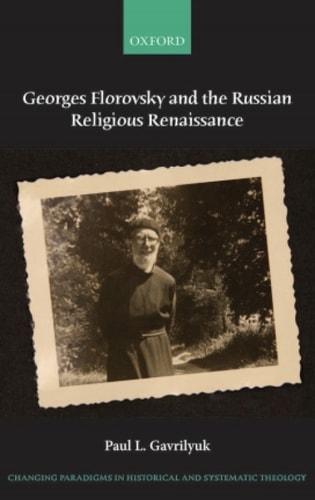
Georges Florovsky and the Russian Religious Renaissance: Changing Paradigms in Historical and Systematic Theology
0
0
As an Amazon Associate and affiliate partner, Menrva Books earns from qualifying purchases. Learn more
Author Description
Georges Florovsky is the mastermind of a 'return to the Church Fathers' in twentieth-century Orthodox theology. His theological vision-the neopatristic synthesis-became the main paradigm of Orthodox theology and the golden standard of Eastern Orthodox identity in the West. Focusing on Florovsky's European period (1920-1948), this study analyses how Florovsky's evolving interpretation of Russian religious thought, particularly Vladimir Solovyov and Sergius Bulgakov, informed his approach to patristic sources. Paul Gavrilyuk offers a new reading of Florovsky's neopatristic theology, by closely considering its ontological, epistemological and ecclesiological foundations. It is common to contrast Florovsky's neopatristic theology with the 'modernist' religious philosophies of Pavel Florensky, Sergius Bulgakov, and other representatives of the Russian Religious Renaissance. Gavrilyuk argues that the standard narrative of twentieth-century Orthodox theology, based on this polarization, must be reconsidered. The author demonstrates Florovsky's critical appropriation of the main themes of the Russian Religious Renaissance, including theological antinomies, the meaning of history, and the nature of personhood. The distinctive features of Florovsky's neopatristic theology Christological focus, 'ecclesial experience', personalism, and 'Christian Hellenism' are best understood against the background of the main problematic of the Renaissance. Specifically, it is shown that Bulgakov's sophiology provided a polemical subtext for Florovsky's theology of creation. It is argued that the use of the patristic norm in application to modern Russian theology represents Florovsky's theological signature. Drawing on unpublished archival material and correspondence, this study sheds new light on such aspects of Florovsky's career as his family background, his participation in the Eurasian movement, his dissertation on Alexander Herzen, his lectures on Vladimir Solovyov, and his involvement
Menrva's Summary
THE THESIS
This study investigates how Georges Florovsky’s neopatristic synthesis emerged as the dominant paradigm of twentieth-century Orthodox theology through his critical engagement with the Russian Religious Renaissance. Paul L. Gavrilyuk, a scholar of historical and systematic theology, utilizes previously unpublished archival materials and correspondence to challenge the traditional binary that separates Florovsky from thinkers like Sergius Bulgakov. By examining Florovsky’s European period, the author argues that his theology is not a rejection of the Renaissance but a sophisticated appropriation of its core themes, including personhood and the meaning of history.
THE SCOPE MAP
What You Will Find
- Analysis of the ontological, epistemological, and ecclesiological foundations of neopatristic theology.
- Examination of Florovsky’s intellectual development during his European period from 1920 to 1948.
- Detailed study of the polemical relationship between Florovsky’s theology of creation and Bulgakov’s sophiology.
- Insights into Florovsky’s early career, including his work on Alexander Herzen and his involvement in the Eurasian movement.
Scope Limits
- The study focuses primarily on the European period of Florovsky's life and does not provide a comprehensive biography of his later years in the United States.
- The text assumes a foundational knowledge of Eastern Orthodox theological terminology and historical context.
THE AUTHORITY PERSPECTIVE
Scholars and theologians identify this work as a significant revisionist study that complicates the standard narrative of twentieth-century Orthodox intellectual history. Readers frequently note the academic density of the prose and the depth of the archival research, making it a primary resource for those studying the intersection of patristics and modern Russian thought.
Page Count:
320
Publication Date:
2013-01-01
Publisher:
OUP Oxford
ISBN-10:
0191005118
ISBN-13:
9780191005114
Biography
Religion
Philosophy history
Theology
Patristics
Eastern Orthodox
Community Tags
Similar Books
Reader Comments
Share Your Thoughts
No comments yet. Be the first to share your thoughts!