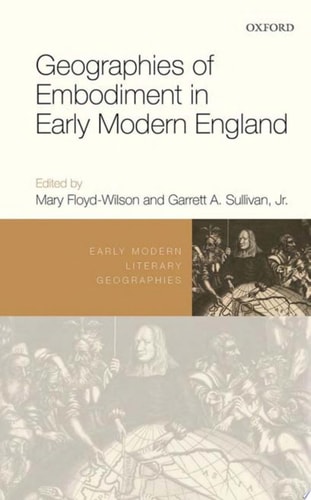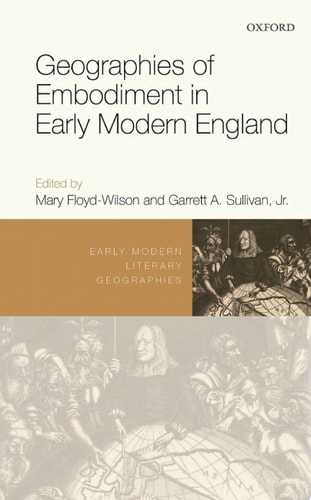
Geographies of Embodiment in Early Modern England
0
0
As an Amazon Associate and affiliate partner, Menrva Books earns from qualifying purchases. Learn more
Author Description
Geographies of Embodiment in Early Modern England gathers essays from prominent scholars of English Renaissance literature and history who have made substantial contributions to the study of early modern embodiment, historical phenomenology, affect, cognition, memory, and natural philosophy. It provides new interpretations of the geographic dimensions of early modern embodiment, emphasizing the transactional and dynamic aspects of the relationship between body and world. The geographies of embodiment encompass both cognitive processes and cosmic environments, and inner emotional states as well as affective landscapes. Rather than always being territorialized onto individual bodies, ideas about early modern embodiment are varied both in their scope and in terms of their representation. Reflecting this variety, this volume offers up a range of inquiries into how early modern writers accounted for the exchanges between the microcosm and macrocosm. It engages with Gail Kern Paster's groundbreaking scholarship on embodiment, humoralism, the passions, and historical phenomenology throughout, and offers new readings of Edmund Spenser, William Shakespeare, Thomas Nashe, John Milton, and others. Contributions consider the epistemiologies of navigation and cartography, the significance of geohumoralism, the ethics of self-mastery, theories of early modern cosmology, the construction of place memory, and perceptions of an animate spirit world.
Menrva's Summary
THE THESIS
This volume investigates the complex, transactional relationship between the human body and the geographic environment in early modern English thought. Editors Garrett A. Sullivan and Mary Floyd-Wilson curate a collection of essays from leading scholars to examine how Renaissance writers conceptualized the interplay between the microcosm of the individual and the macrocosm of the world. By synthesizing historical phenomenology, humoralism, and natural philosophy, the contributors argue that early modern embodiment was not a static condition but a dynamic process shaped by cosmic, cognitive, and affective landscapes.
THE SCOPE MAP
What You Will Find
- Analysis of geohumoralism and its influence on early modern identity.
- Examinations of the epistemologies of navigation and cartography.
- Discussions on the construction of place memory and the perception of animate spirit worlds.
- Scholarly readings of canonical authors including William Shakespeare, Edmund Spenser, and John Milton.
Scope Limits
- The text focuses specifically on the English Renaissance period and does not provide a comprehensive survey of embodiment across all European cultures.
- The volume prioritizes literary and historical analysis over contemporary biological or medical definitions of the body.
THE AUTHORITY PERSPECTIVE
Scholars in the field of early modern studies recognize this collection as a significant contribution to the study of historical phenomenology and the intersection of geography and the body. Readers frequently note the academic density of the prose, which assumes a high level of familiarity with the works of Gail Kern Paster and Renaissance intellectual history.
Page Count:
304
Publication Date:
2020-01-01
Publisher:
OUP Oxford
ISBN-10:
0192594281
ISBN-13:
9780192594280
Philosophy
Cultural History
Science History
Literary Criticism
Renaissance
English
Phenomenology
Early Modern
English & College Success