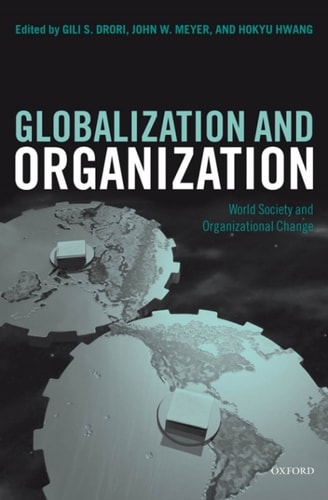
Globalization and Organization: World Society and Organizational Change
0
0
As an Amazon Associate and affiliate partner, Menrva Books earns from qualifying purchases. Learn more
Author Description
All around the world, societies are experiencing an explosion of organizations and organizing: community clubs, religious groups, social movements, as well as schools, hospitals, businesses and government agencies, increasingly take the form of complex and formal organization. Why? Why is global society recast in this format and why so fiercely? This book explores various dimensions of the trends of expansion, formalization, and standardization of organizing worldwide by exploring such organizational legacies as accounting, business management, corporate social responsibility, and performance benchmarks. Featuring contributions from prominent academics, the book argues that these processes can be attributed to globalization and to its specific tendencies of universalism, rationalization, and rise of the modern notion of the strongly bounded and purposive social actor. An application of institutional arguments to global issues, the book will be of interest to academics and researchers of Organization Studies, Sociology, Political Science, and Geography.
Menrva's Summary
THE THESIS
This book investigates the global proliferation of formal organizational structures and the underlying institutional pressures driving this worldwide trend. The authors, Gili S. Drori, Hokyu Hwang, and John W. Meyer, utilize institutional theory to examine how global society increasingly adopts standardized, rationalized, and purposive organizational forms. By analyzing diverse sectors such as business, education, and government, the text argues that these shifts are not merely functional responses but are products of global cultural tendencies toward universalism and the construction of the modern social actor.
THE SCOPE MAP
What You Will Find
- Analysis of organizational expansion in sectors including hospitals, schools, and government agencies
- Examination of specific organizational legacies like accounting, corporate social responsibility, and performance benchmarking
- Application of institutional theory to global social and political phenomena
Scope Limits
- The text does not provide a comprehensive history of every specific organizational type mentioned
- The analysis focuses primarily on institutional and sociological frameworks rather than individual-level psychological motivations
THE AUTHORITY PERSPECTIVE
Experts in organization studies and sociology recognize this work as a significant contribution to the institutionalist perspective on globalization. Readers frequently note the academic density of the prose, making it a text primarily suited for researchers and advanced students in the social sciences.
Page Count:
342
Publication Date:
2006-01-01
Publisher:
Oxford University Press, U.S.A.
ISBN-10:
0191515841
ISBN-13:
9780191515842
Institutional Theory
Special Topics
International business
Organizational change
Principles of Management
Management
Globalization
English & College Success
Sociology
English
Linguistics
Community Tags
Other Editions(3)
Similar Books