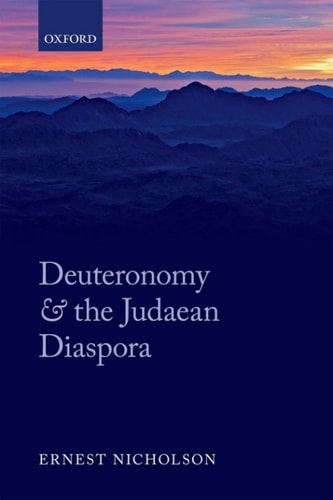
Deuteronomy and the Judaean Diaspora
0
0
As an Amazon Associate and affiliate partner, Menrva Books earns from qualifying purchases. Learn more
Author Description
In Deuteronomy and the Judaean Diaspora Ernest Nicholson challenges the widely accepted view that Deuteronomy was the 'book of the law' described in 2 Kings 22-3 as the basis of king Josiah's cultic reformation in 621 BCE. He argues that the notice in this narrative that Josiah abolished the rural, local altars throughout Judah and supposedly relocated their priests to Jerusalem is based upon a misreading. Rather, he contends, Deuteronomy derived from thinkers and writers who lived among the Judaean exiles in Babylonia in the sixth century, and in significant ways represents a break with pre-exilic Israelite religion occasioned by the urgent need to confront the challenges to national identity and cultural survival of the Judaean Diaspora community. Leading features of the book such as its zealous monolatry, its self-presentation as 'scripture', its concept of the relationship with God as covenanted choice, its pervasive fear of religious encroachment, its character as 'oppositional' literature--these and other themes of the book suggest such a provenance. Issues arising include, for example, information from Babylonian sources, some of it new, about the Judaean exiles, how Israel is characterised in the book, kingship, evidence of the emergence of a body of prophetic 'scripture'. Two final chapters examine the 'Deuteronomistic History' (Joshua-2 Kings) and show that (contrary to some interpretations) it is not 'historiography' such as is represented by, for example, Herodotus' Histories, and that theodicy rather than an interest in the past as a field of critical study best describes its genre.
Menrva's Summary
THE THESIS
Ernest Nicholson investigates the origins of the book of Deuteronomy, challenging the traditional consensus that it served as the foundational law code for King Josiah's seventh-century BCE reforms. Nicholson, a scholar of Old Testament studies, utilizes historical-critical analysis and comparative studies of Babylonian sources to argue that the text emerged from the Judaean exiles in the sixth century BCE. He posits that the work functions as a response to the existential crisis of the Diaspora, prioritizing the preservation of national and religious identity through a distinct, oppositional theological framework.
THE SCOPE MAP
What You Will Find
- Analysis of the relationship between the Deuteronomistic History and the Babylonian exile.
- Examination of the theological themes of monolatry, covenant, and religious exclusivity.
- Evaluation of the genre of the Deuteronomistic History in contrast to classical historiography.
Scope Limits
- The text does not provide a comprehensive archaeological survey of pre-exilic Judah.
- It does not focus on the linguistic evolution of the Hebrew language during the exilic period.
THE AUTHORITY PERSPECTIVE
Scholars recognize this work as a significant contribution to the ongoing debate regarding the dating and provenance of the Pentateuch. Readers frequently note the academic density of the prose, which requires a foundational understanding of biblical criticism to fully engage with the author's arguments.
Page Count:
208
Publication Date:
2014-01-01
Publisher:
OUP Oxford
ISBN-10:
0191007315
ISBN-13:
9780191007316
Religion
History
Near East
Bibles
Theology
Community Tags
Other Editions(2)

Similar Books