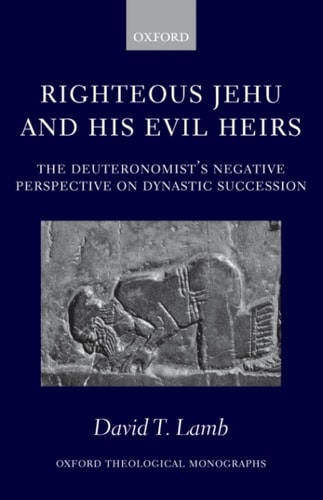
Righteous Jehu and His Evil Heirs: The Deuteronomist's Negative Perspective on Dynastic Succession
0
0
As an Amazon Associate and affiliate partner, Menrva Books earns from qualifying purchases. Learn more
Author Description
David T. Lamb examines not only the dynasty of Jehu within the narrative of 2 Kings, but also the broader context of the dynasties of Israel and Judah in the books of Kings and Samuel. Lamb discusses religious aspects of kingship (such as anointing, divine election, and prayer) in both the Old Testament and in the literature of the ancient Near East. He concludes that the Deuteronomistic editor, because of a deep concern that leaders be divinely chosen and obedient to Yahweh, sought to subvert the monarchical status quo by shaping the Jehuite narrative to emphasize that dynastic succession disastrously fails to produce righteous leaders.
Menrva's Summary
THE THESIS
This work investigates why the Deuteronomistic historian presents dynastic succession in the books of Kings and Samuel as a failure, specifically focusing on the dynasty of Jehu. David T. Lamb, an expert in Old Testament studies, utilizes a comparative analysis of ancient Near Eastern literature and biblical narrative to argue that the Deuteronomist intentionally subverted the concept of hereditary monarchy. He posits that the author prioritized divine election and strict adherence to Yahweh over the stability of royal bloodlines.
THE SCOPE MAP
What You Will Find
- Comparative analysis of kingship rituals including anointing and prayer
- Examination of the Jehuite narrative within 2 Kings
- Contextual study of dynastic succession in Israel and Judah
Scope Limits
- Does not provide a comprehensive history of all ancient Near Eastern monarchies
- Focuses primarily on the Deuteronomistic perspective rather than archaeological evidence of the period
THE AUTHORITY PERSPECTIVE
Scholars recognize this monograph as a rigorous contribution to the study of Deuteronomistic theology and the political structure of ancient Israel. Readers frequently note the academic density of the prose, which is intended for students and researchers of biblical literature.
Page Count:
288
Publication Date:
2008-01-01
Publisher:
Oxford University Press
ISBN-10:
0191528250
ISBN-13:
9780191528255
Religion
History
Bibles
Theology
Near East
Community Tags
Similar Books