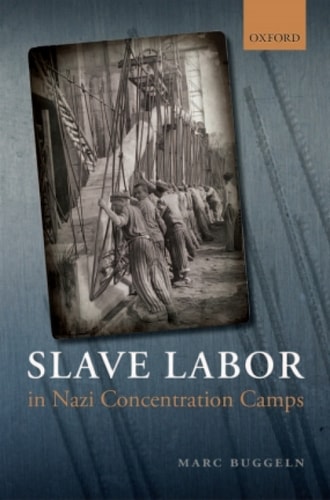
Slave Labor in Nazi Concentration Camps
0
0
As an Amazon Associate and affiliate partner, Menrva Books earns from qualifying purchases. Learn more
Author Description
Slave Labor in Nazi Concentration Camps examines the slave labor carried out by concentration camp prisoners from 1942 and the effect this had on the German wartime economy. This work goes far beyond the sociohistorical 'reconstructions' that dominate Holocaust studies - it combines cultural history with structural history, drawing relationships between social structures and individual actions. It also considers the statements of both perpetrators and victims, and takes the biographical approach as the only possible way to confront the destruction of the individual in the camps after the fact. The first chapter presents a comparative analysis of slave labor across the different concentration camps, including Auschwitz, Buchenwald, and Dachau. The subsequent chapters analyse the similarities and differences between various subcamps where prisoners were utilised for the wartime economy, based on the example of the 86 subcamps of Neuengamme concentration camp, which were scattered across northern Germany. The most significant difference between conditions at the various subcamps was that in some, hardly any prisoners died, while in others, almost half of them did. This work carries out a systematic comparison of the subcamp system, a kind of study which does not exist for any other camp system. This is of great significance, because by the end of the war most concentration camps had placed over 80 percent of their prisoners in subcamps. This work therefore offers a comparative framework that is highly useful for further examinations of National Socialist concentration camps, and may also be of benefit to comparative studies of other camp systems, such as Stalin's gulags.
Menrva's Summary
THE THESIS
This work investigates the integration of slave labor into the German wartime economy and the resulting impact on the concentration camp system from 1942 onward. Marc Buggeln, a historian specializing in the National Socialist era, utilizes a structural and cultural historical framework to analyze the intersection of state-mandated labor policies and individual human experience. By synthesizing archival data with perpetrator and victim testimonies, the author argues that the subcamp system was the primary mechanism for prisoner exploitation during the latter half of the war.
THE SCOPE MAP
What You Will Find
- Comparative analysis of major concentration camps including Auschwitz, Buchenwald, and Dachau
- Detailed examination of the 86 subcamps associated with Neuengamme
- Analysis of mortality rates and labor conditions across diverse camp environments
- Methodological framework for comparing camp systems
Scope Limits
- Does not provide a comprehensive history of the entire Holocaust beyond the specific context of labor exploitation
- Focuses primarily on the German wartime economy rather than broader political history
THE AUTHORITY PERSPECTIVE
Scholars recognize this text as a rigorous contribution to Holocaust studies due to its systematic comparative methodology. Readers frequently note the academic density of the prose and the author's meticulous use of primary source documentation.
Page Count:
352
Publication Date:
2014-01-01
Publisher:
OUP Oxford
ISBN-10:
0191017647
ISBN-13:
9780191017643
History
Military History
Social History
World War
Jewish History
Slave Labor
Community Tags
Similar Books