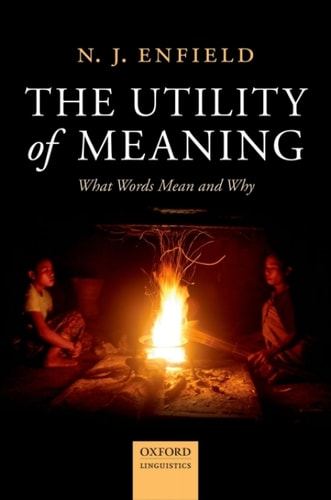
The Utility of Meaning: What Words Mean and Why
0
0
As an Amazon Associate and affiliate partner, Menrva Books earns from qualifying purchases. Learn more
Author Description
This book argues that the complex, anthropocentric, and often culture-specific meanings of words have been shaped directly by their history of 'utility' for communication in social life. N. J. Enfield draws on semantic and pragmatic case studies from his extensive fieldwork in Laos to investigate a range of semantic fields including emotion terms, culinary terms, landscape terminology, and honorific pronouns, among many others. These studies form the building blocks of a conceptual framework for understanding meaning in language. The book argues that the goals and relevancies of human communication are what bridge the gap between the private representation of language in the mind and its public processes of usage, acquisition, and conventionalization in society. Professor Enfield argues that in order to understand this process, we first need to understand the ways in which linguistic meaning is layered, multiple, anthropocentric, cultural, distributed, and above all, useful. This wide-ranging account brings together several key strands of research across disciplines including semantics, pragmatics, cognitive linguistics, and sociology of language, and provides a rich account of what linguistic meaning is like and why.
Menrva's Summary
THE THESIS
This book investigates how the utility of words in social communication shapes their complex, culture-specific meanings. N. J. Enfield, a professor of linguistics, utilizes his extensive fieldwork in Laos and cross-disciplinary research to propose a conceptual framework for linguistic meaning. He argues that the gap between private mental representations and public language usage is bridged by the practical goals and relevancies inherent in human interaction.
THE SCOPE MAP
What You Will Find
- Analysis of semantic fields including emotion, culinary, landscape, and honorific terminology
- A framework connecting cognitive linguistics with the sociology of language
- Examination of how meaning is layered, distributed, and conventionalized
Scope Limits
- The text does not provide a comprehensive dictionary or exhaustive list of all linguistic meanings
- It does not focus on historical etymology outside of its functional utility for social communication
THE AUTHORITY PERSPECTIVE
Experts recognize this work as a significant contribution to the study of pragmatics and cognitive linguistics. Readers frequently note the academic density of the prose, which is intended for scholars and students of language sciences.
Page Count:
272
Publication Date:
2014-01-01
Publisher:
OUP Oxford
ISBN-10:
0191019763
ISBN-13:
9780191019760
Linguistics
Semantics
Sociology of Language
English
Pragmatics
Communication Studies
English & College Success
Community Tags
Similar Books