Political Conversations in Late Republican Rome
0
0
As an Amazon Associate and affiliate partner, Menrva Books earns from qualifying purchases. Learn more
Author Description
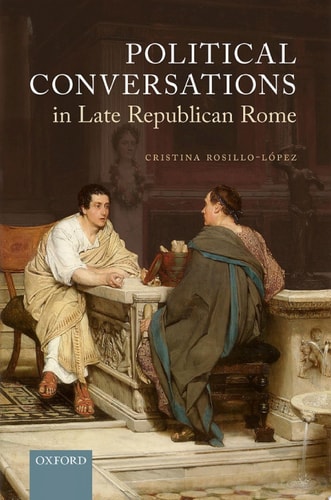
Political Conversations in Ciceronian Rome offers for the first time a perspective of Roman politics through the proxy of conversations and meetings. In Rome oral was the default mode of communication in politics: oratory before the people in assemblies, addresses and discussions in the Senate, speeches in the law courts, rumours, and public opinion. We are familiar with the notion that the Roman political world of the Late Republic included lofty speeches and sessions of the Senate, but an important aspect of Late-Republican politics revolved around senators talking among themselves, chatting off in the corner. Only when they could not reach each other in person, Roman senators and their peers resorted to letters. This book intends to analyse political conversations and illuminate the oral dimension of Roman politics. It posits that the study of politics should not be restricted to the senatorial group, but that other persons should be considered as important political actors with their own agency (albeit in different degrees), such as freedmen and elite women. It argues that Roman senators and their entourages met in person to have conversations in which they discussed politics, circulated political information and negotiated strategies; this extra-institutional sphere had a relevant impact both on politics and institutions as well as determined how the Roman Republic functioned.
Menrva's Summary
THE THESIS
This book investigates how informal, oral communication and private conversations functioned as a primary mechanism for political decision-making in the Late Roman Republic. Cristina Rosillo-López, a scholar specializing in Roman political culture, utilizes a synthesis of primary source evidence—including letters, speeches, and historical accounts—to argue that the Roman political system relied heavily on an extra-institutional sphere of interaction. By shifting the focus from formal senatorial sessions to the interpersonal exchanges between senators, freedmen, and elite women, the author demonstrates that these private dialogues were essential to the negotiation of political strategy and the circulation of information.
THE SCOPE MAP
What You Will Find
- Analysis of oral communication as the default mode of Roman political interaction.
- Examination of the political agency of non-senatorial actors, including freedmen and elite women.
- Investigation into the intersection of private conversation and institutional function.
Scope Limits
- The study focuses primarily on the Late Republican period and does not extend to the administrative shifts of the Imperial era.
- The analysis does not provide a comprehensive history of formal senatorial procedure, focusing instead on the informal spaces surrounding it.
THE AUTHORITY PERSPECTIVE
Scholars recognize this work as a significant contribution to the study of Roman political culture, particularly for its emphasis on the oral and informal dimensions of power. Readers frequently note the academic rigor of the text, which provides a nuanced understanding of how social interaction shaped the governance of the Republic.
Page Count:
304
Publication Date:
2021-01-01
Publisher:
OUP Oxford
ISBN-10:
0192669001
ISBN-13:
9780192669001
History
Communication Studies
Ancient - Rome
English
English & College Success
Italy history
Community Tags
Similar Books