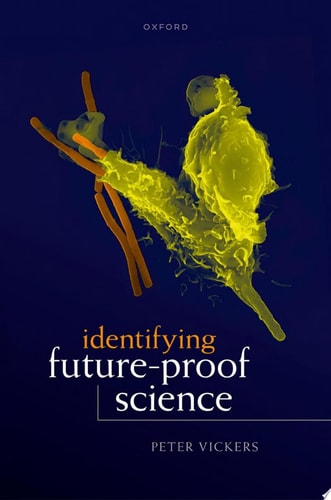
Identifying Future-Proof Science
0
0
As an Amazon Associate and affiliate partner, Menrva Books earns from qualifying purchases. Learn more
Author Description
Is science getting at the truth? The sceptics - those who spread doubt about science - often employ a simple argument: scientists were 'sure' in the past, and then they ended up being wrong. Through a combination of historical investigation and philosophical-sociological analysis, Identifying Future-Proof Science defends science against this potentially dangerous scepticism. Indeed, we can confidently identify many scientific claims that are future-proof: they will last forever, so long as science continues. How do we identify future-proof claims? This appears to be a new question for science scholars, and not an unimportant one. Peter Vickers argues that the best way to identify future-proof science is to avoid any attempt to analyse the relevant first-order scientific evidence, instead focusing purely on second-order evidence. Specifically, a scientific claim is future-proof when the relevant scientific community is large, international, and diverse, and at least 95% of that community would describe the claim as a 'scientific fact'. In the entire history of science, no claim meeting these criteria has ever been overturned, despite enormous opportunity.
Menrva's Summary
THE THESIS
How can we distinguish scientific claims that are likely to remain true indefinitely from those that are subject to future revision? Peter Vickers, a philosopher of science, addresses the challenge posed by scientific skepticism by proposing a novel framework for identifying 'future-proof' knowledge. Rather than evaluating first-order scientific evidence, he argues that we should rely on second-order evidence, specifically the consensus and diversity of the global scientific community.
THE SCOPE MAP
What You Will Find
- A historical analysis of past scientific claims that have been overturned.
- A proposed methodology for identifying future-proof science based on community size, international diversity, and consensus thresholds.
- A philosophical defense of scientific realism against skeptical arguments.
Scope Limits
- The book does not provide a comprehensive history of all scientific disciplines.
- It does not attempt to analyze the technical first-order evidence of specific scientific theories.
THE AUTHORITY PERSPECTIVE
Experts in the philosophy of science recognize this work as a provocative contribution to the debate on scientific realism and the nature of consensus. Readers frequently note the clarity of the author's argument and the accessibility of his proposed criteria for evaluating scientific claims.
Page Count:
279
Publication Date:
2022-01-01
Publisher:
OUP Oxford
ISBN-10:
0192677217
ISBN-13:
9780192677211
Philosophy history
Science History
Epistemology
Earth Sciences
Sociology of Science
Philosophy of