Formalizing Displacement
0
0
As an Amazon Associate and affiliate partner, Menrva Books earns from qualifying purchases. Learn more
Author Description
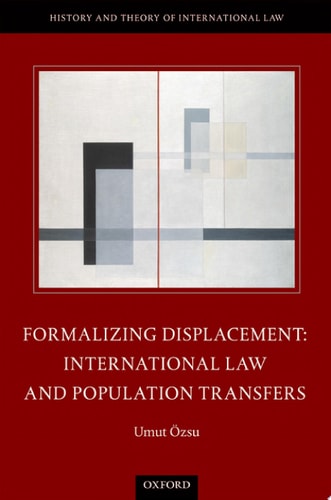
Large-scale Population Transfers Are Immensely Disruptive. Interestingly, Though, Their Legal Status Has Shifted Considerably Over Time. In This Book, Umut Özsu Situates Population Transfer Within The Broader History Of International Law By Examining Its Emergence As A Legally Formalized Mechanism Of Nation-building In The Early Twentieth Century. The Book's Principal Focus Is The 1922-34 Compulsory Exchange Of Minorities Between Greece And Turkey, A Crucially Important Endeavour Whose Legal Dimensions Remain Under-scrutinized. Drawing Upon Historical Sociology And Economic History In Addition To Positive International Law, The Book Interrogates Received Assumptions About International Law's History By Exploring The 'semi-peripheral' Context Within Which Legally Formalized Population Transfers Came To Arise. Supported By The League Of Nations, The 1922-34 Population Exchange Reconfigured The Demographic Composition Of Greece And Turkey With The Aim Of Stabilizing A Region That Was Regarded Neither As European Nor As Non-european. The Scope And Ambition Of The Undertaking Was Staggering: Over One Million Were Expelled From Turkey, And Over A Quarter Of A Million Were Expelled From Greece. The Book Begins By Assessing Minority Protection's Development Into An Instrument Of Intra-european Governance During The Course Of The Nineteenth And Early Twentieth Centuries. It Then Shows How Population Transfer Emerged In The 1910s And 1920s As A Radical Alternative To Minority Protection In Anatolia And The Balkans, Focusing In Particular On The 1922-3 Conference Of Lausanne, At Which A Peace Settlement Formalizing The Compulsory Greek-turkish Exchange Was Concluded. Finally, It Analyses The Permanent Court Of International Justice's 1925 Advisory Opinion In Exchange Of Greek And Turkish Populations, Contextualizing It In The Wide-ranging Debates Concerning Humanitarianism And Internationalism That Pervaded Much Of The Exchange Process.
Menrva's Summary
THE THESIS
This book investigates how the legal status of large-scale population transfers evolved from an informal practice into a formalized mechanism of nation-building within international law. Umut Özsu, a scholar of international law and legal history, utilizes a multidisciplinary framework to analyze the 1922-34 compulsory exchange of minorities between Greece and Turkey. By integrating historical sociology, economic history, and positive international law, the author challenges conventional narratives regarding the development of international legal norms in the early twentieth century.
THE SCOPE MAP
What You Will Find
- Analysis of the 1922-34 compulsory population exchange between Greece and Turkey.
- Examination of the 1922-3 Conference of Lausanne and its role in formalizing population transfers.
- Review of the Permanent Court of International Justice's 1925 advisory opinion.
- Exploration of the 'semi-peripheral' geopolitical context of the Balkans and Anatolia.
Scope Limits
- The study does not provide a comprehensive history of all global population transfers.
- The analysis focuses primarily on the legal and institutional mechanisms rather than individual personal narratives of the displaced.
THE AUTHORITY PERSPECTIVE
Scholars and legal historians recognize this work as a rigorous examination of the intersection between international law and state-sponsored demographic engineering. Readers frequently note the academic density of the prose, which serves as a foundational text for those studying the evolution of minority protection and international governance.
Page Count:
208
Publication Date:
2014-01-01
Publisher:
Oup Oxford
ISBN-10:
0191026883
ISBN-13:
9780191026881
Middle Eastern
International Law
Legal History
Sociology
European History
Community Tags
Similar Books