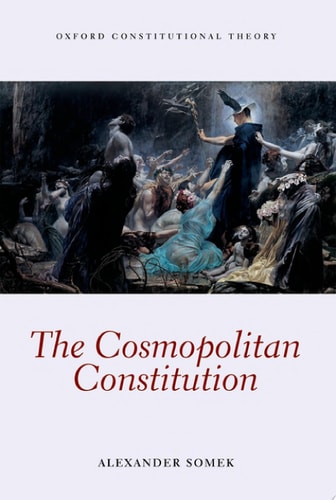
The Cosmopolitan Constitution
0
0
As an Amazon Associate and affiliate partner, Menrva Books earns from qualifying purchases. Learn more
Author Description
Originally The Constitution Was Expected To Express And Channel Popular Sovereignty. It Was The Work Of Freedom, Springing From And Facilitating Collective Self-determination. After The Second World War This Perspective Changed: The Modern Constitution Owes Its Authority Not Only To Collective Authorship, It Also Must Commit Itself Credibly To Human Rights. Thus People Recede Into The Background, And The National Constitution Becomes Embedded Into One Or Other System Of 'peer Review' Among Nations. This Is What Alexander Somek Argues Is The Creation Of The Cosmopolitan Constitution. Reconstructing What He Considers To Be The Three Stages In The Development Of Constitutionalism, He Argues That The Cosmopolitan Constitution Is Not A Blueprint For The Constitution Beyond The Nation State, Let Alone A Constitution Of The International Community; Rather, It Stands For Constitutional Law Reaching Out Beyond Its National Bounds. This Cosmopolitan Constitution Has Two Faces: The First, Political, Face Reflects The Changed Circumstances Of Constitutional Authority. It Conceives Itself As Constrained By International Human Rights Protection, Firmly Committed To Combating Discrimination On The Grounds Of Nationality, And To Embracing Strategies For Managing Its Interaction With Other Sites Of Authority, Such As The United Nations. The Second, Administrative, Face Of The Cosmopolitan Constitution Reveals The Demise Of Political Authority, Which Has Been Traditionally Vested In Representative Bodies. Political Processes Yield To Various, And Often Informal, Strategies Of Policy Co-ordination So Long As There Are No Reasons To Fear That The Elementary Civil Rights Might Be Severely Interfered With. It Represents Constitutional Authority For An Administered World.
Menrva's Summary
THE THESIS
This work investigates how the concept of constitutional authority has shifted from an expression of popular sovereignty to a framework constrained by international human rights and administrative coordination. Alexander Somek, a scholar of legal theory, utilizes a historical and analytical framework to trace the evolution of constitutionalism. He argues that modern constitutions are increasingly embedded in international systems of peer review, resulting in a dual-faced structure that balances human rights commitments with the decline of traditional representative political authority.
THE SCOPE MAP
What You Will Find
- A three-stage historical reconstruction of the development of constitutionalism.
- An analysis of the political face of constitutional authority, focusing on international human rights and non-discrimination.
- An examination of the administrative face of constitutionalism, highlighting the shift toward informal policy coordination.
Scope Limits
- The text does not provide a blueprint for a singular global constitution or a formal constitution for the international community.
- It does not focus on the internal mechanics of specific national legal systems, but rather on the broader conceptual shift in constitutional law.
THE AUTHORITY PERSPECTIVE
Legal scholars and political theorists frequently cite this text for its rigorous examination of the changing nature of sovereignty in a globalized era. Readers often note the academic density of the prose, which requires a strong background in legal philosophy to fully grasp the author's arguments regarding the administrative state.
Page Count:
320
Publication Date:
2014-01-01
Publisher:
Oup Oxford
ISBN-10:
0191030910
ISBN-13:
9780191030918
Human rights
International relations
Political Theory
Law
Constitutional Law
Community Tags
Other Editions(3)

Similar Books











Reader Comments
Share Your Thoughts
No comments yet. Be the first to share your thoughts!