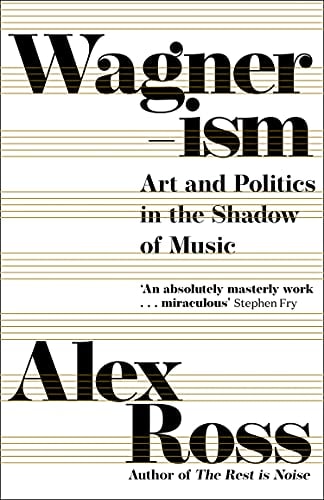
Wagnerism: Art and Politics in the Shadow of Music
0
0
As an Amazon Associate and affiliate partner, Menrva Books earns from qualifying purchases. Learn more
Author Description
’An absolutely masterly work’ Stephen FryAlex Ross, renowned author of the international bestseller The Rest Is Noise, reveals how Richard Wagner became the proving ground for modern art and politics―an aesthetic war zone where the Western world wrestled with its capacity for beauty and violence.For better or worse, Wagner is the most widely influential figure in the history of music. Around 1900, the phenomenon known as Wagnerism saturated European and American culture. Such colossal creations as The Ring of the Nibelung, Tristan und Isolde, and Parsifal were models of formal daring, mythmaking, erotic freedom, and mystical speculation. A mighty procession of writers, artists, and thinkers, including Charles Baudelaire, Virginia Woolf, Isadora Duncan, Vasily Kandinsky, and Luis Buñuel, felt his impact. Anarchists, occultists, feminists, and gay-rights pioneers saw him as a kindred spirit. Then Adolf Hitler incorporated Wagner into the soundtrack of Nazi Germany, and the composer came to be defined by his ferocious anti-Semitism. His name is now almost synonymous with artistic evil.Wagnerism restores the magnificent confusion of what it means to be a Wagnerian. A pandemonium of geniuses, madmen, charlatans, and prophets do battle over Wagner’s many-sided legacy. The narrative ranges across artistic disciplines, from architecture to the novels of Philip K. Dick, from the Zionist writings of Theodor Herzl to the civil-rights essays of W. E. B. Du Bois, from O Pioneers! to Apocalypse Now. In many ways,Wagnerism tells a tragic tale. An artist who might have rivalled Shakespeare in universal reach is implicated in an ideology of hate. Still, his shadow lingers over twenty-first century culture, his mythic motifs coursing through superhero films and fantasy fiction. Neither apologia nor condemnation, Wagnerism is a work of intellectual passion, urging us toward a more honest idea of how art acts in the world.
Menrva's Summary
THE THESIS
Wagnerism explores the profound and often contradictory influence of Richard Wagner's music and ideas on the development of modern art and politics. Alex Ross, a renowned author and critic, investigates how Wagner's colossal creations and complex legacy became a battleground for cultural and ideological forces at the turn of the 20th century. The book examines the diverse figures and movements, from artists and writers to anarchists and political ideologues, who engaged with Wagner's work, highlighting both its aesthetic daring and its entanglement with dangerous ideologies, particularly his virulent anti-Semitism and its later appropriation by the Nazi regime. Ross navigates this intricate landscape, aiming not for simple condemnation or defense, but for an honest understanding of art's role in shaping the world.
THE SCOPE MAP
- The pervasive cultural phenomenon of Wagnerism around 1900 across Europe and America.
- Analysis of Wagner's major works like 'The Ring of the Nibelung' and 'Tristan und Isolde' as models of artistic innovation.
- The impact of Wagner on a wide array of artists, writers, and thinkers including Baudelaire, Woolf, Kandinsky, and Buñuel.
- Exploration of how various political and social movements, such as anarchism, feminism, and early gay-rights activism, found resonance in Wagner's work.
- The dark side of Wagnerism: his virulent anti-Semitism and its horrific co-option by Adolf Hitler and Nazi Germany.
- The book's narrative scope, spanning disciplines from architecture and literature to Zionism and civil rights.
- A nuanced examination of Wagner's legacy, neither purely celebratory nor condemnatory, focusing on art's complex relationship with ideology and societal impact.
THE AUTHORITY PERSPECTIVE
Alex Ross's 'Wagnerism' has been met with significant critical acclaim, with Stephen Fry calling it 'an absolutely masterly work.' The book is recognized for its intellectual rigor and its comprehensive exploration of Richard Wagner's far-reaching influence on modern culture. Critics highlight Ross's ability to navigate the composer's complex legacy, balancing his immense artistic contributions with his deeply problematic anti-Semitism and its historical consequences. The work is praised for its broad scope, connecting Wagner's impact across diverse artistic and political spheres, and for its nuanced approach that seeks an honest understanding of art's power in the world.
Page Count:
784
Publication Date:
2021-09-16
Publisher:
Fourth Estate
ISBN-10:
000842294X
ISBN-13:
9780008422943
Biography
Non-Fiction
History
Art And Music
Cultural History
Music and literature
Music History
Art History
Music
Political Aspects
Literary Criticism
Criticism history
Community Tags
Other Editions(2)
Similar Books

Reader Comments
Share Your Thoughts
No comments yet. Be the first to share your thoughts!