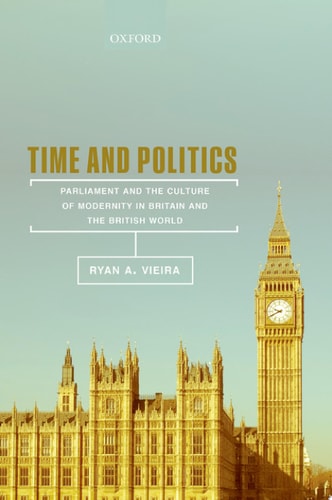
Time and Politics: Parliament and the Culture of Modernity in Britain and the British World
0
0
As an Amazon Associate and affiliate partner, Menrva Books earns from qualifying purchases. Learn more
Author Description
Time and Politics is the first cultural and transnational history of modern procedural reform in the Westminster parliamentary system. The study centres on the nineteenth-century emergence of a desire to modernise and make more efficient the procedural rules of parliamentary law-making. Contrary to existing interpretations, which see this as a product of transformations in political structure and practice, this volume demonstrates how the evolution of Parliament's rules was structured by transformations within the wider culture of time. Ryan Vieira argues that the spread of an increasingly rigorous time discipline in concert with a growing consciousness of being modern worked to progressively erode the legitimacy of the historically developed rules of parliamentary debate and law-making, while simultaneously implanting new ways of judging the effectiveness of parliamentary institutions. By the 1880s, this process had transformed efficiency into the ultimate criteria of parliamentary effectiveness. Using the conceptual framework of the British world, Time and Politics demonstrates how this new understanding of parliamentary effectiveness was exported to the colonies of settlement through a series of communicative networks and provided colonial parliamentarians with the ability to imagine the inefficiencies of their own legislatures as part of a larger transnational problem. In making these arguments, this volume lays the groundwork for a new type of parliamentary history.
Menrva's Summary
THE THESIS
How did the cultural perception of time and modernity reshape the procedural foundations of the Westminster parliamentary system during the nineteenth century? Ryan A. Vieira, a scholar of British political history, utilizes a transnational framework to argue that parliamentary reform was not merely a structural evolution but a consequence of shifting temporal consciousness. By examining the rise of rigorous time discipline, Vieira demonstrates how efficiency became the primary metric for institutional legitimacy across Britain and its colonial settlements.
THE SCOPE MAP
What You Will Find
- Analysis of nineteenth-century procedural reforms in the Westminster system.
- Examination of the 'British world' as a transnational network for political ideas.
- Investigation into the cultural history of time and its impact on legislative debate.
Scope Limits
- The study focuses primarily on the nineteenth century and does not provide an exhaustive history of parliamentary procedure into the contemporary era.
- The analysis is limited to the Westminster model and its direct colonial offshoots, excluding non-British parliamentary traditions.
THE AUTHORITY PERSPECTIVE
Scholars recognize this work as a significant contribution to the cultural history of political institutions, noting its innovative approach to connecting temporal philosophy with legislative practice. Readers frequently highlight the academic density of the prose, which is well-suited for researchers and students of parliamentary history.
Page Count:
240
Publication Date:
2015-01-01
Publisher:
OUP Oxford
ISBN-10:
0191057495
ISBN-13:
9780191057496
History
Parliamentary Studies
Cultural History
Modernity
British History
European History
Community Tags
Similar Books